A basin faucet can be moved only a few centimetres—from the countertop to the wall—yet that small change affects plumbing, cleaning, basin selection, installation timing, and future repairs. With a deck-mounted faucet, much of the installation remains accessible around or below the basin. With a wall-mounted faucet, the visible counter becomes cleaner, but important components may move behind the finished wall.
That makes this choice much more than an interior-design decision.
For most standard family bathrooms, a deck-mounted faucet is generally the more practical option because installation, replacement, and servicing are straightforward. A wall-mounted faucet is an excellent choice for premium or minimalist bathrooms when the basin and concealed plumbing can be planned together before tiling.
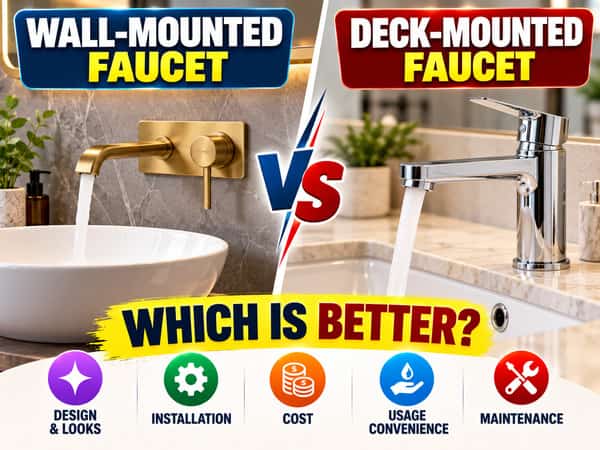
Wall-Mounted vs Deck-Mounted Faucet: Quick Comparison
| Factor | Wall-Mounted Faucet | Deck-Mounted Faucet |
|---|---|---|
| Installation position | Wall above basin | Basin or countertop |
| Appearance | Minimal and premium | Conventional to modern |
| Counter space | Maximum | Uses some surface space |
| Plumbing | Usually concealed in wall | Usually accessible below |
| Installation planning | Critical | More flexible |
| Replacement | Can be more involved | Generally easier |
| Cleaning around faucet | Easier countertop cleaning | Water can collect around base |
| Basin compatibility | Excellent with vessel basins | Very wide compatibility |
| Faucet height issue | Controlled by wall position | Depends on faucet model |
| Renovation | More disruptive | Usually easier |
| Initial installation | More complex | Simpler |
| Best for | Planned premium bathrooms | Most everyday bathrooms |
What Is a Wall-Mounted Faucet?
A wall-mounted faucet is installed on the wall behind or above the wash basin rather than on the basin or counter.
The visible arrangement may include:
- Spout
- Mixer control
- Separate hot/cold controls
- Integrated wall plate
Much of the water connection and mixer body may sit behind the finished wall.
Wall-mounted basin mixers are commonly paired with:
- Countertop vessel basins
- Freestanding bowls
- Minimal vanities
- Premium stone counters
They can create a particularly clean vanity because the counter itself does not need to support the faucet.
Best for: New or completely renovated bathrooms where plumbing locations can be accurately planned before tiling.
What Is a Deck-Mounted Faucet?
A deck-mounted faucet is fixed to a horizontal surface.
The “deck” may be:
- Basin itself
- Countertop
- Vanity top
Many ceramic basins are manufactured with one or more pre-cut tap holes specifically for this installation.
The faucet connects to water supplies from below.
Deck-mounted options include:
- Pillar taps
- Single-lever basin mixers
- Centre-set faucets
- Tall basin mixers
- Multi-hole mixers
Best for: Family bathrooms and renovations where straightforward installation and maintenance are priorities.
Which Looks Better?
Wall-mounted faucets generally provide the more minimalist appearance.
The countertop can remain almost completely uninterrupted except for the basin.
This works particularly well with:
- Vessel basins
- Floating vanities
- Large mirrors
- Stone counters
- Minimalist bathrooms
The faucet can appear to emerge directly from the tiled or stone wall.
Deck-mounted faucets create a more familiar arrangement.
However, modern deck-mounted mixers can be extremely sleek, so wall mounting should not automatically be considered more attractive.
The best option depends on the basin and overall vanity design.
Which Is Better for a Countertop Basin?
Both can work very well.
A vessel-style countertop basin creates one particular challenge: the bowl sits above the counter.
With a deck-mounted faucet, you may therefore need a tall-body basin mixer.
Its height and spout reach must match the bowl.
A wall-mounted faucet avoids the need for a tall mixer because the spout can be positioned at the required height directly above the basin.
This can create a cleaner arrangement.
However, the wall outlet needs to be positioned accurately.
Once tiles are installed, changing the faucet height becomes difficult.
Which Is Better for an Under-Counter Basin?
Deck-mounted faucets are often very practical.
The faucet can be mounted directly through the countertop behind the basin.
This creates a conventional arrangement with easy access to plumbing below.
A wall-mounted faucet can also look excellent with an under-counter basin, particularly when the counter is intended to remain visually uncluttered.
The choice depends largely on whether the bathroom is being designed from scratch or renovated around existing plumbing.
Which Saves More Counter Space?
Wall-mounted faucets win.
Because the faucet is moved onto the wall, more of the vanity surface remains available.
This can be useful on a narrow counter.
The free surface can be used for:
- Soap dispenser
- Toothbrush holder
- Grooming products
- Cosmetics
- Small accessories
However, the space saving should not be exaggerated.
A modern single-lever deck-mounted mixer has a relatively small footprint.
The difference matters most on very narrow or highly minimalist countertops.
Which Is Easier to Clean?
Wall-mounted faucets generally make the countertop easier to clean.
Deck-mounted faucets create a base where water can collect.
Around that base, you may find:
- Water spots
- Soap residue
- Toothpaste
- Mineral deposits
Cleaning behind the faucet can also be awkward when the gap between the mixer and backsplash is narrow.
A wall-mounted faucet removes this obstacle from the counter.
You can wipe the surface more easily.
However, the wall-mounted faucet itself still needs cleaning, particularly around the wall plate and spout.
Which Is Better for Hard Water?
Deck-mounted faucets have an important maintenance advantage: accessibility.
Hard water can cause mineral buildup on either faucet.
It can also affect internal components over time.
With a deck-mounted faucet, many connections are accessible from inside the vanity.
A wall-mounted faucet may contain concealed components behind the wall.
Quality concealed mixers are designed for servicing, but access depends on the product and installation.
If hard water is a major issue, check:
- Cartridge availability
- Aerator accessibility
- Spare parts
- Service procedure
before selecting a concealed wall-mounted system.
Which Is Easier to Install?
Deck-mounted faucets generally win.
The installer can mount the faucet through a prepared hole in the basin or counter and connect the water supply underneath.
This arrangement is familiar and relatively straightforward.
Wall-mounted faucets require more planning.
The installer must correctly determine:
- Faucet position.
- Basin position.
- Finished counter height.
- Basin rim height.
- Spout height.
- Spout reach.
- Concealed-body depth.
- Finished wall thickness.
An error in any of these measurements can affect usability.
Why Finished Wall Thickness Matters
This is particularly important for concealed wall-mounted mixers.
The concealed faucet body is installed before final wall finishing.
Afterward, the wall may receive:
- Plaster
- Waterproofing
- Adhesive
- Tile
- Stone
The final surface can therefore sit considerably farther forward than the unfinished wall.
Concealed faucet bodies normally have specified minimum and maximum installation depths.
If installed too deep or too shallow, the visible trim may not fit correctly.
Always follow the manufacturer’s installation dimensions rather than estimating.
Which Is Easier During Renovation?
Deck-mounted faucets are generally easier.
If an existing bathroom already has water connections around the basin, replacing a deck-mounted mixer may require relatively little disturbance.
Converting to a wall-mounted faucet can involve:
- Opening the wall
- Moving water pipes
- Installing concealed components
- Waterproofing
- Re-tiling
This can make a simple basin upgrade much more expensive.
Wall-mounted faucets make greater sense when the bathroom is already being completely renovated.
Which Is Easier to Repair?
Deck-mounted faucets generally provide easier access.
Water connections and mounting hardware can usually be reached below the basin or inside the vanity.
Replacing the complete faucet is also relatively straightforward.
A wall-mounted faucet needs to be designed for front servicing wherever concealed components are involved.
Routine cartridge replacement may be possible without opening the wall on a properly designed product.
However, major problems with inaccessible concealed plumbing can be more complicated.
This makes product quality and installation especially important.
Do You Need to Break Tiles to Repair a Wall-Mounted Faucet?
Not for every repair.
Replaceable components such as:
- Aerators
- Handles
- Cartridges
- Visible spouts
may be accessible from the finished side depending on the faucet design.
However, concealed plumbing connections sit behind the wall.
A failure in inaccessible pipework or an incorrectly installed concealed body can require wall access.
This is why concealed plumbing should be thoroughly pressure-tested before the wall is permanently closed and tiled.
Which Has Lower Leakage Risk?
Neither mounting style is automatically leak-proof.
A deck-mounted faucet has flexible or rigid water connections below the basin.
Because they are accessible, a leak can often be noticed and repaired relatively quickly.
A wall-mounted faucet moves some plumbing behind the finished wall.
Good concealed systems are designed for this installation, but workmanship becomes extremely important.
Connections should be:
- Correctly made
- Tested
- Properly supported
- Compatible with the fitting
Never conceal questionable plumbing and assume tiles will protect it.
Which Is Better for a Small Bathroom?
Both work well.
A wall-mounted faucet can help a narrow vanity feel less crowded.
This can be useful with a compact countertop basin.
A deck-mounted mixer can be equally practical when the basin includes a factory-made tap hole.
For a very small bathroom, consider the complete vanity depth.
Sometimes using a compact wall-mounted basin with an integrated deck-mounted tap is more space-efficient than building a counter simply to achieve a wall-mounted faucet look.
Which Is Better for a Powder Room?
Wall-mounted faucets are particularly attractive here.
Powder rooms often prioritise visual design over extensive storage.
A decorative countertop bowl paired with a wall-mounted spout can create a strong focal point.
Because powder rooms generally receive shorter periods of basin use than a primary family bathroom, the design-focused arrangement can make sense.
Deck-mounted faucets remain the simpler choice where budget and maintenance matter more.
Which Is Better for a Family Bathroom?
Deck-mounted faucets are generally the practical winner.
A family bathroom needs fixtures that can tolerate frequent use and remain straightforward to maintain.
Deck-mounted mixers provide:
- Easy access
- Familiar operation
- Wide availability
- Easy replacement
- Broad basin compatibility
A wall-mounted mixer can still work perfectly well, but there is less practical benefit if the household does not particularly value the minimalist appearance.
Which Is Better for Children?
Either can work.
The important factor is reach.
Children need to be able to operate the control without leaning awkwardly across the basin.
A wall-mounted mixer installed too high or too far behind a large countertop bowl can be inconvenient.
Similarly, a tall deck-mounted mixer can be difficult to reach if positioned behind a deep basin.
When designing a family bathroom, consider the distance from the front of the vanity to the faucet control.
Which Is Better for Elderly Users?
The mounting type itself is less important than:
- Control design
- Reach
- Operating force
- Basin height
- Clear floor space
Single-lever controls can be easier to operate than separate tight knobs for many users.
A wall-mounted control should not be positioned so far away that the user has to stretch across the basin.
Likewise, a deck-mounted faucet should remain comfortably reachable.
Accessibility should be evaluated using the complete basin arrangement.
Which Is Better for a Floating Vanity?
Both.
A wall-mounted faucet can strengthen the minimal appearance of a floating vanity because the counter remains visually clean.
It can be paired with a countertop bowl for a very modern design.
A deck-mounted faucet is easier to service because connections can remain inside the floating cabinet.
This often provides the best balance between modern appearance and practical maintenance.
Spout Reach Is Critical
Regardless of mounting type, the water should land at an appropriate point inside the bowl.
If the spout is too short, water may hit very close to the back edge.
If it projects too far, water may land too close to the front.
Poor positioning can increase splashing.
When selecting a wall-mounted faucet, consider:
Wall to basin centre + basin shape + spout projection
For a deck-mounted faucet, check:
Faucet position + spout reach + basin dimensions
Do not select a faucet using appearance alone.
Faucet Height Also Matters
Water falling from excessive height can create unnecessary splashing, particularly in a shallow basin.
This is important with:
- Tall vessel basins
- Tall deck-mounted mixers
- Wall-mounted faucets
The correct height depends on the basin geometry and water landing point.
There is no single ideal faucet height for every basin.
Use the basin and faucet manufacturer’s dimensional drawings to plan the combination.
Which Works Better With a Glass Basin?
Wall-mounted faucets can work particularly well with decorative glass vessel basins.
Moving the faucet to the wall allows the bowl and countertop to remain visually prominent.
A tall deck-mounted mixer can also work.
However, glass vessel basins are often sensitive to visual clutter because their transparency is part of the design.
A wall-mounted spout can produce a cleaner composition.
Whichever option is selected, correct spout position is essential to control splashing.
Which Works Better With a Ceramic Basin?
Either.
Ceramic basins offer enormous installation flexibility.
Many have factory-made faucet holes designed for deck-mounted mixers.
In that situation, using the intended deck-mounted arrangement is usually straightforward.
Ceramic countertop bowls without tap holes can pair beautifully with wall-mounted faucets or tall deck mixers.
Check the specific basin before ordering the faucet.
Which Is More Durable?
The visible faucet can be equally durable in either configuration when quality materials and cartridges are used.
Long-term ownership differs mainly in service access.
Deck-mounted faucets are easier to remove completely.
Wall-mounted faucets rely more on the durability of the concealed installation.
For either type, look for quality components such as:
- Reliable cartridge
- Good-quality body material
- Replaceable aerator
- Durable finish
- Available spare parts
A stylish faucet with unavailable replacement cartridges can become frustrating regardless of mounting type.
Which Is More Expensive?
Wall-mounted installations generally cost more as a complete project.
The visible faucet itself may not always be dramatically more expensive, but installation can involve:
- Concealed body
- Additional plumbing
- Wall cutting
- Accurate positioning
- Waterproofing
- Tiling
- More labour
A deck-mounted faucet usually connects to plumbing already available below the basin.
Therefore, compare:
Faucet + concealed components + plumbing + wall finishing + labour
rather than the faucet price alone.
Which Is Better for Rental Properties?
Deck-mounted faucets generally win.
They are:
- Easy to access
- Easy to replace
- Familiar to plumbers
- Widely available
- Suitable for many standard basins
If a tenant damages or wears out the faucet, replacement can usually be straightforward.
Wall-mounted systems make more sense in premium rentals where bathroom design contributes to the property’s overall positioning.
Which Is Better for a Luxury Bathroom?
Wall-mounted faucets often have the visual advantage.
They pair particularly well with:
- Premium countertop basins
- Natural stone counters
- Large mirrors
- Floating vanities
- Minimal interiors
However, a premium deck-mounted faucet can be equally luxurious.
Luxury should not be confused with concealed installation.
A well-proportioned high-quality deck mixer that works perfectly with the basin is better than a poorly positioned wall-mounted faucet chosen purely for appearance.
What Should You Check Before Buying a Wall-Mounted Faucet?
Check:
- Spout projection
- Installation height
- Basin dimensions
- Counter height
- Concealed-body depth
- Finished wall thickness
- Hot/cold plumbing position
- Service access
- Cartridge availability
- Aerator
- Finish
- Warranty
- Spare parts
Most importantly, finalise the basin and faucet together before plumbing and tiling.
Changing the basin later can leave the wall-mounted spout in the wrong position.
What Should You Check Before Buying a Deck-Mounted Faucet?
Check:
- Faucet-hole configuration
- Mounting-hole diameter
- Basin/counter thickness
- Faucet height
- Spout reach
- Basin depth
- Flexible hose connections
- Space underneath
- Cartridge
- Aerator
- Finish
- Spare parts
- Warranty
If the basin has a factory-made tap hole, confirm that the selected faucet fits it properly.
Wall-Mounted or Deck-Mounted Faucet: Which Should You Choose?
Choose a wall-mounted faucet when you want:
- Minimal countertop design
- More free counter surface
- A premium vanity appearance
- A countertop vessel basin
- Easier wiping around the basin
- Concealed plumbing
- A bathroom being designed from scratch
- Precise coordination between plumbing and sanitaryware
Choose a deck-mounted faucet when you want:
- Straightforward installation
- Easier repairs
- Easy faucet replacement
- Broad basin compatibility
- Lower installation complexity
- A practical family bathroom
- A renovation with existing plumbing
- Convenient access to connections
For a standard family bathroom, a quality deck-mounted mixer is generally the more practical choice. It is easy to install, accessible for maintenance, and compatible with a wide range of basins.
For a new premium bathroom, a wall-mounted faucet can be an excellent design choice when the basin position, counter height, spout projection, and concealed plumbing are planned before the wall is finished.
The most important rule is simple: do not choose the faucet independently of the basin. The water needs to land in the correct part of the bowl at a suitable height. A perfectly installed premium faucet can still be frustrating every day if its dimensions do not match the basin.
FAQs
Q1. Which is better, a wall-mounted or deck-mounted faucet?
A. A deck-mounted faucet is generally better for straightforward installation, servicing, and replacement. A wall-mounted faucet is better when you want a minimalist counter and premium appearance and can plan the concealed plumbing accurately before tiling.
Q2. Are wall-mounted faucets difficult to repair?
A. Routine components such as the aerator, handle, or cartridge may be serviceable from the front depending on the model. However, concealed plumbing is less accessible than the connections of a deck-mounted faucet, making correct installation and spare-part availability especially important.
Q3. Which faucet is better for a countertop wash basin?
A. Both can work. A wall-mounted faucet creates a clean appearance and avoids the need for a tall mixer, while a tall deck-mounted faucet is easier to install and service. Spout height and projection must match the countertop basin.
Q4. Do wall-mounted faucets splash more?
A. Not inherently. Splashing usually results from a poor combination of spout height, projection, water pressure, and basin geometry. A correctly positioned wall-mounted faucet can provide excellent splash control.
Q5. Which faucet is better for bathroom renovation?
A. A deck-mounted faucet is generally easier for renovation because it can often use existing water connections below the basin. Converting to a wall-mounted faucet may require opening the wall, relocating pipes, installing concealed components, waterproofing, and re-tiling.