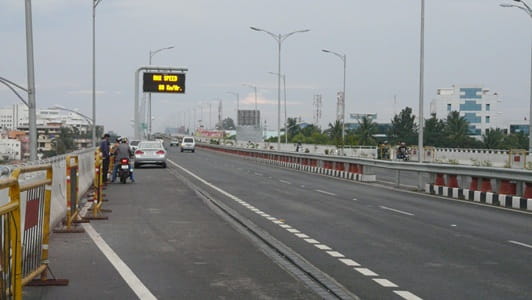
Electronic City Flyover — the official and most complete name for the elevated expressway that transformed Bengaluru’s most economically critical daily commute — is a 9.985 km elevated highway connecting Silk Board Junction to Electronic City along the Hosur Road corridor in Bengaluru’s southeastern technology belt. This infrastructure landmark, inaugurated on 22 January 2010, was constructed by BETL (Bengaluru Elevated Tollways Limited) as part of the National Highways Development Project and stands at 17 metres above Hosur Road — Bengaluru’s tallest flyover at its time of opening. The flyover’s operational impact on the city’s technology economy has been profound and sustained: what was India’s most notorious IT commute bottleneck became one of the country’s most efficient technology park access routes, enabling the productivity, talent retention, and real estate development that has made Electronic City one of South Asia’s most important technology employment hubs.
Electronic City itself is one of India’s most significant planned technology parks — a multi-phase industrial estate spanning approximately 800 acres across Phase 1 and Phase 2 that houses the Indian operations of companies including Infosys, Wipro, HCL Technologies, HP, Siemens, Texas Instruments, and dozens of other global and Indian technology organisations. The combined workforce of over 150,000 professionals makes Electronic City one of the world’s most concentrated single-location technology employment zones. The flyover’s 10 km elevated express connection from this massive workforce to Bengaluru’s central residential and commercial zones is the infrastructure backbone that makes this concentration viable and sustainable.
Quick Overview Table — Electronic City Flyover Bengaluru
| Parameter | Details |
| Full Name | Electronic City Elevated Expressway |
| Location | Silk Board Junction to Electronic City, Hosur Road, Bengaluru — 560100 |
| Length | 9.985 km (6.2 miles) |
| Height | 17 metres above Hosur Road |
| Inaugurated | 22 January 2010 |
| Developer/Operator | BETL (Bengaluru Elevated Tollways Limited) |
| National Highways | NH 275 and NH 75 |
| Exits | Phase 1, Phase 2, Konappana Agrahara |
| Nearest Metro | Konappana Agarhara / Electronic City Metro (Yellow Line) |
| Key Bus Routes | 500-DC, 600-C, 600-F, 346-A, 346-K, 361-C, NICE-10, KIA-8 |
| Toll | Yes — paid on exit at Electronic City |
| PIN Code | 560100 (Electronic City end) / 560068 (Bengaluru approach) |
| Best For | Hosur Road daily commuters, Electronic City IT workforce, airport transit |
Electronic City Flyover, Bengaluru Location and Address
The Electronic City Flyover spans Hosur Road from Silk Board Junction (approximately PIN Code 560068 for the approach zone) to Electronic City Phase 1 and Phase 2 at approximately PIN Code 560100. The Silk Board Junction starting point is one of Bengaluru’s most well-known — and most notorious — road intersections, where the Outer Ring Road from the western and northern city meets Hosur Road heading southeast and Bannerghatta Road heading south. The junction’s central significance in Bengaluru’s arterial road network makes it the most critical traffic management point in the southern city’s infrastructure.
At the Electronic City end, the flyover connects to the organised road network of Electronic City Industrial Area — the planned technology park development with its own internal road system, security gates, and campus infrastructure. The three exits at the Electronic City end allow organised distribution of the enormous daily traffic volumes across Phase 1 and Phase 2 campuses and the Konappana Agrahara residential zone — preventing congestion at any single exit point.
The Bengaluru Electronic City Flyover’s address context — on NH 275 (Bengaluru-Salem highway) and NH 75 approaches — confirms the flyover’s position on India’s national highway network. This national highway designation reflects the flyover’s economic importance as infrastructure connecting a major metropolitan area’s technology employment zone to its national highway network, justifying the National Highways Development Project funding that enabled its construction.
Directions — Getting To and Through the Electronic City Flyover
From Silk Board Junction (Northbound Approach) Vehicles approaching the Electronic City Flyover from Bengaluru city — from Koramangala, BTM Layout, HSR Layout, and the Outer Ring Road — converge at Silk Board Junction and enter the flyover ramps on either side of Hosur Road. The ramp access requires vehicle positioning in the flyover-bound lanes well before the junction — with two separate carriageways (inbound and outbound relative to Electronic City), vehicles must choose the correct lane approaching the ramp.
During peak morning hours (7:30–10:30 AM), the Electronic City-bound flyover carries enormous traffic volumes as the IT workforce begins the workday commute. During evening peak hours (5:30–9:30 PM), the Silk Board-bound carriageway carries the return commute. Off-peak hours allow the flyover’s design capacity to provide genuinely smooth highway-speed travel in both directions.
From Hosur Road and Tamil Nadu Vehicles approaching from the Tamil Nadu direction — from Hosur (approximately 35 km), Krishnagiri, Vellore, and Chennai via NH 44 — enter the Electronic City Flyover from its southern end at Electronic City. These vehicles use the Phase 1 or Phase 2 entry ramps to travel northwestward on the elevated expressway toward Silk Board Junction and then into Bengaluru city. The inter-state commuter population from Tamil Nadu’s border towns that work in Electronic City represents a significant component of the flyover’s daily traffic.
Service Roads Parallel service roads on both sides of Hosur Road beneath the flyover serve vehicles accessing the intermediate localities — Hulimavu, Begur, Gottigere, and the residential developments along Hosur Road’s length. These service roads provide the local accessibility that the elevated flyover’s expressway character cannot directly serve.
Routes and Transit Connectivity
Namma Metro Yellow Line — Electronic City Stations The Namma Metro Yellow Line’s Electronic City stations — specifically Konappana Agarhara (Electronic City Metro Station) confirmed at approximately 18 minutes from the flyover base — provide the most reliable and most traffic-independent transit access. The Yellow Line extension specifically designed for the Electronic City technology park corridor has multiple stations serving the Phase 1, Phase 2, and Konappana Agrahara zones. From Bengaluru City Railway Station via the Yellow Line, Electronic City is reachable in approximately 40–50 minutes — competitive with the flyover drive during peak hours when approach roads at Silk Board create pre-flyover delays.
BMTC Bus Routes The Electronic City Flyover is served by BMTC routes 361-C, 378, 500-DC, 600-C, 600-F, V-500E, 346-A, 346-K, 346-M, NICE-10, NICE-2, NICE-5K, NICE-6T, 356-CW, 201-G, 349, 349-A, HSS-19, KVASC-12, and the airport-connecting KIA-8 route series. E-City SBI Junction bus stop (55 metres from flyover base) serves as the primary departure point. BMTC’s Vajra AC Volvo service to Electronic City provides comfortable, budget-friendly transit specifically targeting the IT workforce demographic.
Airport Connectivity — KIA Routes The KIA-8 route family connects Electronic City directly to Kempegowda International Airport — a significant connectivity advantage for the international business travellers and NRI professionals who comprise a substantial portion of the Electronic City workforce. This airport-to-technology-park direct connection was specifically developed to serve the Electronic City catchment.
Nearby Places — Technology, Education, and Infrastructure
Infosys Electronic City Foundation Campus Infosys’s historic Electronic City campus — where the company was founded and where generations of Indian software engineers began their careers — is directly accessible from the flyover’s Phase 1 exit. The campus hosts the Infosys Foundation activities alongside technology operations. The SBI Electronic City branch directly at the flyover’s base serves the enormous daily financial transaction needs of the technology workforce.
Wipro and Major Technology Campuses Wipro, HCL, HP, Siemens, and dozens of global technology companies maintain major campuses within Electronic City — accessible from the Phase 1 and Phase 2 exits. The campus architecture, security infrastructure, and scale of these technology parks create the distinctive character of Electronic City as a globally significant technology employment hub.
Crown Plaza Hotel Crown Plaza Electronic City — a five-star hotel directly within the technology park zone — provides premium hospitality for corporate visitors, client entertainment, and business accommodation. The hotel’s conference facilities serve the enormous business meeting volume generated by the global technology companies’ client visits.
Shikaripalya and Residential Ecology The residential areas surrounding Electronic City — Shikaripalya, Konappana Agrahara village, Begur, and Gollahalli — provide the local community ecosystem of shops, temples, restaurants, and the neighbourhood character that organically develops around large employment zones.
Frequently Asked Questions (FAQs)
Q: What is the full name of the Electronic City Flyover?
A: Electronic City Elevated Expressway — also known as E City Flyover, Electronic City Flyover, and the BETL Flyover.
Q: When was the Electronic City Flyover inaugurated?
A: 22 January 2010 — as part of BETL (Bengaluru Elevated Tollways Limited) under the National Highways Development Project.
Q: How much does it cost to use the Electronic City Flyover?
A: A toll is charged at the Electronic City end. Toll rates vary by vehicle type — cars, motorcycles, and commercial vehicles have different applicable charges.
Q: How does the flyover improve the Silk Board to Electronic City commute?
A: The flyover reduced the pre-construction 90–120 minute peak-hour commute to approximately 10–15 minutes — an 80–90% reduction in travel time.
Q: What companies are in Electronic City accessible from the flyover?
A: Infosys, Wipro, HCL Technologies, HP India, Siemens, Texas Instruments, and over 200 other technology companies operate in Electronic City’s Phase 1 and Phase 2 campuses.