Plaster is often judged only after painting, when both cement and gypsum surfaces can look almost identical. The real differences appear earlier—and sometimes years later—in curing, drying time, wall thickness, moisture exposure, cracking, finishing work and construction speed.
For Indian homes, gypsum plaster is generally the more convenient choice for dry internal walls when the substrate and workmanship are suitable, because it provides a smooth finish and does not require the water-curing process associated with cement plaster. Cement plaster remains the more versatile option, particularly for external walls, bathrooms and other areas where moisture exposure is a concern.
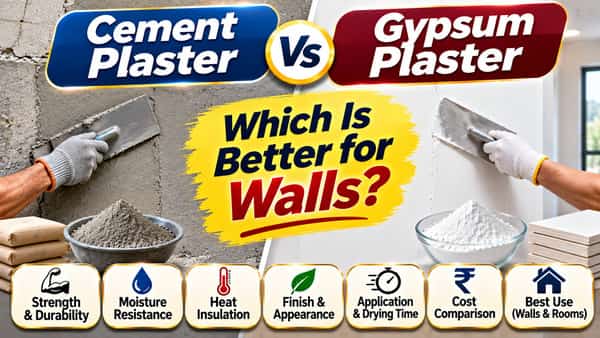
The best house may therefore use both rather than choosing one material everywhere.
Cement Plaster vs Gypsum Plaster: Quick Comparison
| Factor | Cement Plaster | Gypsum Plaster |
|---|---|---|
| Main materials | Cement, sand and water | Gypsum-based plaster |
| Typical application | Internal and external | Mainly internal |
| Wet-area suitability | Better | Generally avoided in persistently damp areas |
| Water curing | Required | Generally not required |
| Setting/drying | Slower construction cycle | Faster |
| Surface finish | May need additional finishing | Naturally smoother |
| Shrinkage cracking | Possible if mix/curing is poor | Generally less prone to drying shrinkage |
| Weight | Heavier | Lighter |
| Thermal properties | Conventional | Better insulating characteristics |
| Fire performance | Good mineral finish | Naturally good fire-resistant characteristics |
| Labour process | More stages | Faster application |
| External walls | Suitable | Generally not preferred |
| Bathrooms | Commonly suitable with proper system | Not the default choice for wet exposure |
| Best use | External/wet/general-purpose plastering | Dry internal walls and ceilings |
What Is Cement Plaster?
Cement plaster is generally made using cement, sand and water and is applied over masonry or concrete to create a protective and reasonably even surface.
It is one of the most familiar wall-finishing systems in India.
BIS maintains IS 1661:1972 – Code of Practice for Application of Cement and Cement-Lime Plaster Finishes, which covers plaster application on walls, columns, ceilings and surfaces such as brick, stone and concrete.
Advantages of Cement Plaster
- Suitable for internal and external walls
- Appropriate for many moisture-exposed applications
- Familiar to Indian contractors
- Works on brick, block and concrete backgrounds
- Robust conventional finish
- Materials are widely available
- Suitable beneath many exterior finishes
- Can accommodate uneven masonry
BIS building guidance describes cement plaster as being used particularly for external plastering while also being usable internally. It gives typical illustrative proportions of around 1:6 cement-to-sand internally and 1:3 to 1:4 externally depending on the surface and climatic conditions.
The actual mix and thickness should follow the project’s specification rather than being selected from a generic ratio alone.
Best for: Exterior walls, moisture-prone areas and projects requiring a traditional general-purpose plastering system.
What Is Gypsum Plaster?
Gypsum plaster is a gypsum-based wall-finishing material primarily intended for interior surfaces.
Instead of preparing cement and sand mortar at the site, packaged gypsum plaster is mixed and applied to the wall according to the manufacturer’s specified process.
BIS maintains IS 2547 (Part 1):1976 for gypsum building plaster excluding premixed lightweight plaster, as well as IS 2547 (Part 2) for premixed lightweight plasters.
Advantages of Gypsum Plaster
- Smooth internal finish
- Faster application
- No conventional water-curing stage
- Lightweight
- Good thermal characteristics
- Useful acoustic properties
- Good fire-resistant characteristics
- Less prone to drying shrinkage
- Can reduce additional finishing work
BIS describes gypsum plastering as a faster alternative for internal surfaces because it does not require the time-consuming water-curing process associated with traditional cement-sand plaster. It also highlights its smooth finish, low weight and thermal, acoustic and fire-resistant characteristics.
Best for: Bedrooms, living rooms, offices and other dry internal walls where a smooth, fast finish is desirable.
Which Gives a Smoother Finish?
Gypsum plaster generally has the advantage.
It can produce a fine, smooth surface directly during plastering when correctly applied.
This can reduce the amount of subsequent levelling or finishing required before painting.
Cement plaster normally produces a comparatively coarser surface. Depending on the required paint finish and workmanship, additional finishing material may be used to create a very smooth wall.
This distinction is particularly noticeable where homeowners want clean, flat contemporary interiors.
However, a smooth surface should not be confused with a straight wall.
Neither gypsum nor cement plaster can economically correct seriously misaligned masonry without increasing thickness and material consumption.
Good blockwork or brickwork remains important.
Does Gypsum Plaster Need Water Curing?
One of gypsum plaster’s biggest construction advantages is that it does not require the conventional water-curing process used for cement plaster.
BIS specifically identifies the absence of this time-consuming curing process as an advantage of gypsum plaster for internal surfaces.
Cement plaster needs appropriate curing so that cement hydration can proceed and the plaster can develop the intended properties.
This difference matters on a house construction site.
Cement plaster requires workers, water and time for curing. Poor curing can contribute to weak or cracked finishes.
Gypsum sets through its own hydration process after being mixed with the appropriate amount of water and does not require subsequent water curing in the same way.
For projects in areas where water conservation is important, this can be a meaningful advantage.
Which Is Faster?
Gypsum plaster generally provides a faster internal finishing cycle.
There are two main reasons.
First, it does not require conventional post-application water curing.
Second, gypsum can develop its finished surface relatively quickly.
BIS building guidance notes that gypsum plaster mixtures can set rapidly, with the exact working and setting characteristics depending on the formulation.
Cement plaster involves application followed by curing and adequate drying before subsequent wall finishes can proceed.
Across hundreds or thousands of square metres of wall area, eliminating some of these stages can reduce the overall finishing schedule.
For an individual room, the saving may appear small. Across an apartment building or large house, it becomes much more noticeable.
Which Is Better for External Walls?
Cement plaster is the clear choice between these two for conventional exterior wall plastering.
External walls are exposed to rain, humidity, temperature changes and weather.
BIS guidance specifically identifies cement plaster as commonly used externally and gypsum plaster as mainly intended for internal use.
Gypsum’s sensitivity to persistent moisture makes ordinary internal gypsum plaster unsuitable as a direct substitute for conventional exterior cement plaster.
For an Indian home, cement-based external rendering combined with the appropriate exterior coating or waterproofing system is the more conventional approach.
Which Is Better for Bathrooms?
Cement plaster is generally the safer conventional choice for bathrooms and other areas exposed to significant moisture.
A bathroom wall may experience plumbing leaks, condensation, splashing or failed tile joints.
Gypsum plaster should not be assumed to be suitable simply because tiles will eventually cover it.
The suitability depends on the specific gypsum product, waterproofing system, tile system and manufacturer’s approved application.
For continuously or regularly moisture-exposed areas, cement-based backgrounds are generally more appropriate.
In a home using gypsum throughout bedrooms and living spaces, cement plaster can still be specified selectively in bathrooms and other wet zones.
Which Is Better for Kitchens?
A kitchen is more complicated than a bathroom.
Many kitchen walls remain dry during normal use, so gypsum plaster can work well in suitable dry areas.
However, walls immediately around sinks, plumbing points and other areas with greater moisture exposure require more careful treatment.
Where cabinets cover the wall, the quality and straightness of the underlying plaster also matter.
The safest strategy is to match the plaster to the exposure rather than applying one material indiscriminately throughout the entire kitchen.
Which Is Less Likely to Crack?
Gypsum plaster has an advantage regarding drying shrinkage.
BIS guidance notes that gypsum plaster does not undergo the same drying and setting expansion/shrinkage behaviour associated with conventional cement-sand work and describes it as less prone to cracking.
Cement plaster can develop shrinkage cracks when there are problems with:
- Excess cement
- Poor sand grading
- Too much water
- Excessive plaster thickness
- Inadequate curing
- Rapid drying
- Poor workmanship
But not every crack in a wall originates from plaster.
Movement between RCC columns and masonry, structural deflection, poorly treated joints, plumbing chases and thermal movement can produce cracks regardless of the plaster material.
Gypsum plaster therefore does not make a wall “crack-proof.”
Which Is Better Over AAC Blocks?
Gypsum plaster can pair well with accurate AAC blockwork for dry internal walls.
AAC blocks are factory-made and can create relatively straight wall surfaces. When the masonry is accurate, a relatively controlled gypsum finish can complement it well.
However, AAC is also porous, so surface preparation and the plaster manufacturer’s application requirements are important.
For exterior faces of AAC walls, a suitable external cementitious rendering or another approved weather-resistant system is generally more appropriate than ordinary internal gypsum plaster.
At RCC-to-AAC junctions, proper treatment is important to reduce the risk of cracking caused by differences in movement between materials.
Which Is Better Over Red Bricks?
Both systems can be used internally over appropriate brick masonry.
Cement plaster has traditionally been used extensively over red brick because it can accommodate the relatively rough and sometimes irregular surface.
Gypsum can also be applied internally over suitable masonry backgrounds when the surface has been prepared correctly.
The condition of the brickwork matters.
If the wall is badly uneven, a large quantity of gypsum may be needed merely to correct the masonry. That can reduce its cost and speed advantages.
Good masonry workmanship therefore benefits both plastering systems.
Which Is Better Over Concrete?
Cement plaster can be applied to concrete when the surface is appropriately prepared. IS 1661 specifically covers cement and cement-lime plaster finishes on backgrounds including plain and reinforced concrete.
Gypsum can also be used on suitable internal concrete surfaces, but smooth RCC surfaces may require appropriate preparation or bonding treatment according to the plaster manufacturer’s instructions.
Simply applying plaster over dusty, oily or extremely smooth concrete can result in poor bonding.
Surface preparation matters as much as plaster selection.
Which Is Better for Thermal Insulation?
Gypsum has better inherent thermal characteristics than conventional dense cement plaster.
BIS describes gypsum plaster as providing good thermal properties, while its low weight also means it adds relatively little dead load to a building.
However, homeowners should keep the scale of this benefit in perspective.
Plaster is a relatively thin layer.
The wall material—such as AAC, brick or concrete block—plus wall thickness, insulation, windows, roof and shading will generally have a much greater influence on overall heat transfer.
Choose gypsum for its combination of finish and construction advantages rather than expecting plaster alone to transform the home’s energy performance.
Which Has Better Fire Performance?
Gypsum has particularly useful fire-resistant characteristics.
Gypsum contains chemically combined water in its crystalline structure. BIS notes its high concentration of crystal water and non-combustible nature as beneficial characteristics for building applications.
Cement plaster is also a non-combustible mineral-based finish.
The fire resistance of an actual wall, however, depends on the complete assembly—including masonry, plaster thickness, joints and penetrations.
Where a specified fire rating is required, use a tested wall system rather than selecting plaster from a general comparison.
Cement Plaster vs Gypsum Plaster Cost
Cost should be compared per square metre of finished, paint-ready wall, not merely by the price of a bag.
Cement plaster involves:
- Cement
- Sand
- Mixing
- Application labour
- Curing water
- Curing labour/time
- Drying time
- Potential additional finishing
Gypsum plaster involves:
- Packaged gypsum material
- Mixing
- Skilled application
- No conventional curing
- Faster finishing
- Potentially less additional surface correction
Gypsum material itself can be more expensive than the raw materials used for cement plaster.
But faster construction, no conventional curing and a smoother finish can offset part of that difference.
Local labour rates, sand prices, plaster thickness and wall quality can change the calculation substantially.
Get quotations based on the same wall area and final finish specification.
Can Gypsum Plaster Replace Wall Putty?
Sometimes gypsum plaster can create a sufficiently smooth substrate that the amount of subsequent levelling material is reduced.
But gypsum plaster and wall putty do not perform exactly the same job.
The paint manufacturer may still specify primer, putty or another preparation system depending on the surface and desired finish.
Therefore, homeowners should avoid accepting the blanket claim that gypsum plaster means “no putty ever.”
The complete painting system should be selected according to the gypsum and paint manufacturers’ requirements.
Cement Plaster or Gypsum Plaster: Which Should You Choose?
For a modern Indian home, the strongest solution is often not choosing one plaster for every wall.
Use gypsum plaster for dry internal spaces such as:
- Bedrooms
- Living rooms
- Dining areas
- Corridors
- Dry office/study areas
- Suitable internal ceilings
It provides a smooth finish, eliminates conventional water curing and can speed up interior work. BIS specifically describes gypsum plaster as an internal plaster with useful thermal, acoustic and fire-resistant properties.
Use cement plaster for external and moisture-prone locations such as exterior walls and other surfaces requiring a more conventional moisture-resistant cementitious background. BIS guidance identifies cement plaster as particularly suitable for external plastering.
For bathrooms and consistently wet areas, a properly designed cementitious background and waterproofing system is generally preferable to ordinary gypsum plaster.
If the contractor has little experience with gypsum, workmanship should also influence the decision. A theoretically superior material installed badly can produce a worse result than a familiar material applied correctly.
For many new Indian houses, therefore, a practical combination is:
Gypsum plaster inside dry rooms + cement plaster outside and in wet/moisture-prone areas.
FAQs
Q1. Which is better, cement plaster or gypsum plaster?
A. Neither is better everywhere. Gypsum plaster is generally more convenient for dry internal walls because it provides a smooth finish and does not require conventional water curing. Cement plaster is more versatile and is generally preferable for exterior and moisture-prone surfaces.
Q2. Can gypsum plaster be used on exterior walls?
A. Ordinary gypsum building plaster is mainly intended for internal applications and should not normally replace a suitable exterior rendering system. BIS guidance identifies cement plaster as commonly used externally and gypsum plaster mainly for internal use.
Q3. Does gypsum plaster need curing?
A. Gypsum plaster does not require the conventional post-application water-curing process used with cement plaster. BIS identifies this as one reason gypsum plastering can be faster for internal surfaces.
Q4. Is gypsum plaster suitable for bathrooms?
A. Ordinary gypsum plaster is generally not the first choice for walls exposed to persistent moisture. Cement-based plaster combined with an appropriate waterproofing and tile system is usually more suitable for wet areas. Always follow the specified system for the particular bathroom construction.
Q5. Which plaster is less likely to crack?
A. Gypsum plaster is generally less susceptible to drying-shrinkage cracking than conventional cement-sand plaster. However, structural movement, poor junction detailing and bad workmanship can cause cracks in either system, so gypsum should not be considered crack-proof.