Avinashi Road Flyover is one of the most important urban transport structures in Coimbatore. It is built along the busy Avinashi Road corridor, which is a major arterial stretch connecting the city center with the airport, IT parks, educational institutions, and intercity highways.
Avinashi Road itself is part of National Highway 544, making it one of the most crucial roadways in Coimbatore. Over the years, increasing traffic from rapid urbanization, IT development, industrial growth, and airport expansion made this corridor highly congested. The flyover was developed to reduce signal delays and ensure smooth traffic flow across one of the busiest stretches in the city.
Today, Avinashi Road Flyover plays a major role in improving connectivity for daily commuters, airport travelers, students, IT professionals, and intercity vehicles moving through Coimbatore.
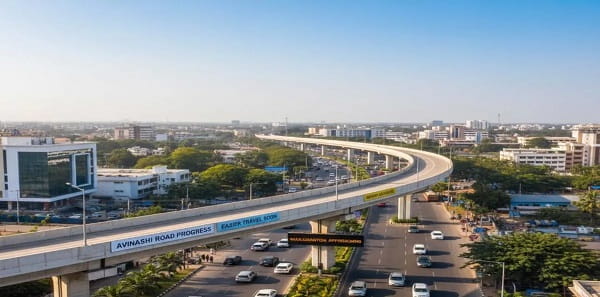
| Parameter | Details |
| Name | Avinashi Road Flyover |
| Location | Avinashi Road Corridor (Gandhipuram–Peelamedu–Airport Stretch) |
| City | Coimbatore |
| State | Tamil Nadu |
| Main Road | NH 544 (Avinashi Road) |
| Nearby Areas | Gandhipuram, Lakshmi Mills, Peelamedu, Hope College |
| Direction Served | City Centre ↔ Airport ↔ Tiruppur ↔ Salem |
| Nearest Railway Station | Coimbatore Junction |
| Nearest Airport | Coimbatore International Airport |
| Purpose | Reduce congestion on Avinashi Road corridor |
| Governing Authority | Highways Department / Coimbatore Corporation |
| Best For | Airport travel, IT commute, intercity highway traffic |
Location and Address
Avinashi Road Flyover is located along Avinashi Road, one of the most significant highways passing through the heart of Coimbatore. The stretch connects multiple key urban zones, including Gandhipuram, Lakshmi Mills Junction, Peelamedu, Hope College, and the airport corridor.
This area is a high-density urban zone with a mix of commercial establishments, IT parks, hospitals, shopping malls, educational institutions, and residential apartments. Because of this, traffic movement remains constant throughout the day.
The flyover is strategically placed to separate long-distance highway traffic from local city traffic, improving overall movement efficiency in this important corridor.
Directions — Getting To and Through Avinashi Road Flyover
Reaching Avinashi Road Flyover is straightforward because it lies on the main city highway.
If you are coming from Gandhipuram, you can directly travel east on Avinashi Road toward Peelamedu and airport direction, passing through the flyover.
From Coimbatore Junction railway station, you can reach the flyover via Race Course Road and Lakshmi Mills Junction.
If you are coming from Peelamedu or Hope College, the flyover lies directly on Avinashi Road toward the city center.
From Coimbatore International Airport, Avinashi Road provides a straight route into the city, passing through the flyover stretch.
From Tiruppur or Salem highway, vehicles enter Avinashi Road and move through the flyover toward central Coimbatore.
The flyover helps bypass major junction signals and reduces travel delays significantly.
However, during peak hours, traffic congestion still occurs due to high vehicle density.
Routes and Transit Connectivity
Avinashi Road Flyover connects several major transport routes:
Avinashi Road (NH 544)
Main highway connecting Coimbatore with Tiruppur and Salem.
Trichy Road Connection
Provides access to eastern and southern parts of the city.
Race Course Road
Connects administrative and commercial zones.
Peelamedu Road Network
Important IT and residential corridor.
Airport Road
Direct route to Coimbatore International Airport.
Railway Connectivity
Coimbatore Junction Railway Station serves as the main railway hub.
Airport Connectivity
Coimbatore International Airport is directly accessible via Avinashi Road.
Bus Connectivity
TNSTC and city buses operate frequently on this corridor.
Public Transport
Autos, taxis, and app-based cab services are widely available.
Nearby Places
Avinashi Road Flyover is surrounded by several important landmarks in Coimbatore.
Gandhipuram
The main commercial and transport hub of the city.
Lakshmi Mills Junction
A key shopping and business area.
Peelamedu
A major residential and IT development zone.
Hope College
An important educational and commercial landmark.
PSG College of Technology
One of the top engineering institutions in Tamil Nadu.
Tidel Park Coimbatore
An IT park located along Avinashi Road corridor.
Coimbatore International Airport
A major airport serving domestic and international flights.
Traffic Conditions and Peak Hours
Traffic on Avinashi Road Flyover is typically heavy due to its importance as a city highway corridor.
Morning (8–11 AM) and evening (5–9 PM) are peak hours when office commuters, students, and airport passengers increase traffic load.
The presence of IT parks, hospitals, and shopping centers also adds to continuous movement throughout the day.
Weekend evenings often see additional congestion due to shopping and leisure activities.
Even though the flyover reduces signal delays, heavy traffic still builds up during peak hours due to high urban density.
Importance of Avinashi Road Flyover
Avinashi Road Flyover is one of the most important infrastructure developments in Coimbatore.
It helps in:
- Reducing congestion on Avinashi Road
- Improving airport connectivity
- Supporting IT and industrial traffic
- Enhancing city-to-highway movement
- Reducing signal delays at major junctions
It is especially important for airport passengers and daily office commuters.
Development and Urban Growth
Coimbatore has experienced rapid growth in IT, education, and industrial sectors. Avinashi Road has become a major spine of this development.
The rise of IT parks, educational institutions, hospitals, and commercial complexes has significantly increased traffic demand in this corridor.
The flyover supports this growth by improving road capacity and reducing congestion.
Future infrastructure upgrades are expected to further improve traffic flow along this route.
Daily Commuting Experience
For daily commuters, Avinashi Road Flyover provides faster and more reliable travel compared to signal-based road movement.
It reduces waiting time and improves connectivity between key zones of the city.
However, due to increasing population and vehicle growth, congestion still remains a challenge during peak hours.
Role in City Connectivity
Avinashi Road Flyover plays a crucial role in Coimbatore’s transport network.
It connects:
- City center (Gandhipuram)
- Airport zone
- IT corridors (Peelamedu, Tidel Park)
- Highway routes toward Tiruppur and Salem
This makes it one of the most important mobility corridors in the city.
Safety and Driving Tips
Driving on Avinashi Road Flyover requires caution:
- Maintain lane discipline
- Avoid overspeeding
- Watch for airport-bound traffic
- Be careful during peak hours
- Follow traffic rules strictly
Future Scope and Improvements
Coimbatore is continuously developing its infrastructure. Future improvements may include:
- Metro rail proposals along Avinashi Road
- Junction redesign and widening
- Smart traffic management systems
- Improved airport connectivity upgrades
- Better pedestrian facilities
These developments will further improve traffic flow in the coming years.
Conclusion
Avinashi Road Flyover is a vital transport infrastructure in Coimbatore that supports daily commuting, airport connectivity, and highway traffic movement.
Despite heavy traffic conditions during peak hours, it remains one of the most important corridors in Coimbatore, ensuring smooth connectivity between the city’s key commercial, residential, and industrial zones.
FAQ — Avinashi Road Flyover
Q1. Why is Avinashi Road Flyover important?
A: It improves traffic flow in Coimbatore and connects major commercial, IT, and airport zones.
Q2. Which airport is nearby?
A: Coimbatore International Airport is directly connected via Avinashi Road.
Q3. Which railway station is nearby?
A: Coimbatore Junction Railway Station is the nearest major station.
4. Why is traffic heavy here?
A: Due to airport traffic, IT offices, commercial centers, and intercity movement.
5. Is this route well connected?
A: Yes, it has strong road, rail, and airport connectivity.