The basin itself may occupy only a small part of a bathroom, but everything around it determines how useful that area becomes. Toothbrushes need somewhere to sit, toiletries need storage, water splashes need to be wiped, and people need enough room to stand comfortably. This is why choosing between a countertop wash basin and a wall-mounted wash basin is really a decision about the entire wash area—not just the ceramic bowl.
A countertop basin sits on a counter or vanity, creating opportunities for storage and a more substantial bathroom design. A wall-mounted basin is fixed directly to the wall and can leave the floor beneath it open.
For a master or family bathroom where storage and premium appearance matter, a countertop basin is generally the better choice. For a compact bathroom, powder room or budget-conscious space where openness and simplicity matter more, a wall-mounted basin can be more practical.
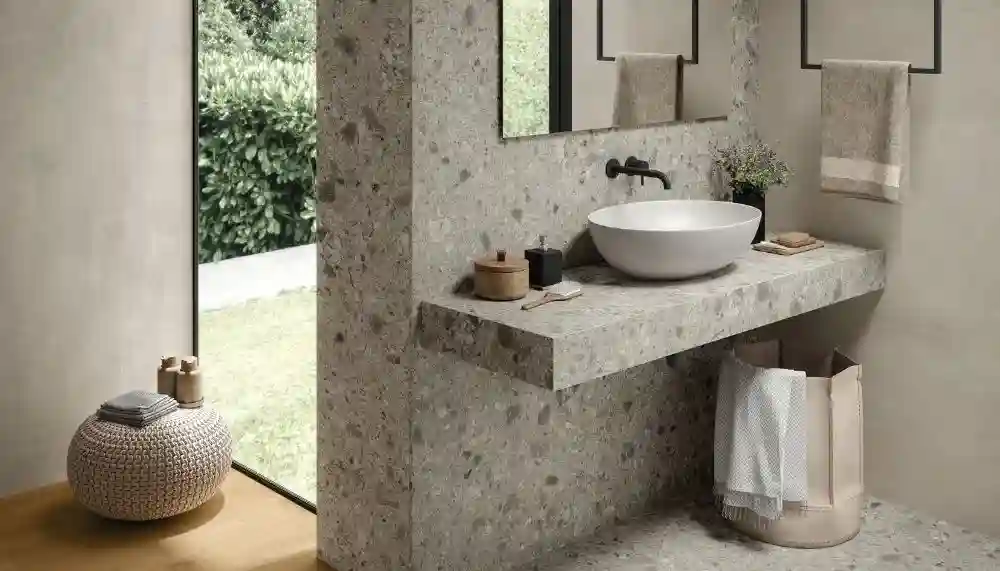
Countertop Basin vs Wall-Mounted Basin: Quick Comparison
| Factor | Countertop Wash Basin | Wall-Mounted Wash Basin |
|---|---|---|
| Installation | On vanity/counter | Fixed directly to wall |
| Cabinet required | Usually used with one | No |
| Storage potential | Excellent | Limited unless added separately |
| Counter space | Available depending on design | Usually minimal |
| Visual appearance | Premium and decorative | Clean and simple |
| Floor visibility | Depends on vanity | Excellent |
| Small bathroom suitability | Good with compact vanity | Excellent |
| Cleaning | Basin + countertop | Basin and wall area |
| Installation complexity | More components | Generally simpler |
| Plumbing concealment | Easy inside vanity | May remain visible or need cover |
| Cost | Usually higher as a complete setup | Usually lower |
| Accessibility potential | Good if properly designed | Excellent design flexibility |
| Best for | Master/family bathrooms | Compact and minimalist bathrooms |
What Is a Countertop Wash Basin?
A countertop basin is installed on top of a horizontal counter or vanity.
The bowl remains largely visible above the counter rather than being fully recessed into it.
These basins are available in many shapes:
- Round
- Oval
- Rectangular
- Square
- Bowl-shaped
- Sculptural designs
The tap may be mounted on the basin, counter or wall depending on the model.
Manufacturers such as Jaquar and Hindware offer countertop basins across a wide range of sizes and forms, making them particularly common in contemporary Indian bathrooms.
Best for: Master bathrooms, family bathrooms and vanity areas where storage and visual impact are important.
What Is a Wall-Mounted Wash Basin?
A wall-mounted wash basin is attached directly to the bathroom wall.
It does not need a countertop or floor-standing vanity to support it.
Depending on the installation, plumbing below the basin may be:
- Exposed
- Covered with a bottle trap
- Hidden inside the wall
- Covered with a pedestal or semi-pedestal
The absence of cabinetry can make the wash area feel lighter and more open.
Best for: Compact bathrooms, powder rooms, guest toilets and spaces where simplicity is more important than built-in storage.
Which Looks Better?
Countertop basins generally create greater visual impact.
The basin becomes a deliberate design feature rather than simply a functional fixture.
Countertop designs work especially well with:
- Stone counters
- Quartz surfaces
- Large mirrors
- Floating vanities
- Wall-mounted faucets
- Premium lighting
- Large-format tiles
A wall-mounted basin creates a different look.
It is simpler and visually lighter.
This can be desirable in minimalist interiors where the goal is to avoid filling the bathroom with cabinetry.
Neither is inherently more stylish—the design language is simply different.
Which Is Better for a Small Bathroom?
Wall-mounted basins generally have the advantage when floor area is extremely limited.
Because they do not require a full vanity, they can reduce visual bulk.
The floor remains visible underneath, which can make the bathroom appear more open.
Compact wall-hung basins are especially useful in:
- Powder rooms
- Guest toilets
- Narrow bathrooms
- Under-stair washrooms
However, countertop basins should not automatically be ruled out.
A compact floating vanity with a countertop basin can provide storage without occupying the floor visually.
This can be an excellent compromise in a small modern bathroom.
Which Provides More Storage?
Countertop installations clearly win.
A vanity beneath the basin can provide space for:
- Toiletries
- Cleaning products
- Towels
- Toilet paper
- Grooming products
- Spare soap
- Bathroom accessories
Drawers can be particularly useful because they allow items to be organised without reaching into a deep cabinet.
A wall-mounted basin has no built-in storage unless separate furniture or shelving is installed.
This difference becomes important in a family bathroom where several people use the same space every day.
Which Provides More Counter Space?
Countertop installations usually win again—but only if the vanity is designed properly.
A large vanity with a reasonably sized basin can leave useful space for:
- Soap dispenser
- Toothbrush holder
- Grooming products
- Cosmetics
- Small accessories
But an oversized vessel basin on a narrow counter can consume almost all available surface area.
Measure the basin and countertop together.
The goal is not simply to fit the basin onto the slab. There should still be enough usable surface around it for the way the bathroom will actually be used.
Which Is Easier to Clean?
Each has different cleaning challenges.
A wall-mounted basin has fewer surrounding surfaces.
There is no vanity top to wipe and no basin-to-counter perimeter collecting water.
The open floor underneath is also easy to mop.
A countertop basin adds another junction:
Basin + counter
Water, soap residue and dust can collect around the basin base if the area is difficult to reach.
However, a properly sized counter with sufficient space around the bowl can still be easy to maintain.
Avoid placing a large bowl so close to the wall that your hand or cleaning cloth cannot comfortably reach behind it.
Which Is Better for Splash Control?
This depends more on basin and faucet geometry than installation type.
A poorly matched countertop basin can splash badly if:
- The bowl is too shallow
- The tap is too high
- The spout is too short
- Water lands near the edge
- Water pressure is excessive
The same problem can occur with a wall-mounted basin.
Ideally, water from the spout should fall comfortably into the basin rather than striking a steep surface or the drain in a way that throws water outward.
The basin and faucet should therefore be selected as a pair.
Faucet Height Matters With Countertop Basins
This is especially important with vessel-style countertop bowls.
Because the basin sits above the counter, a conventional short faucet may not provide enough clearance.
The project may require:
- Tall-body basin mixer
- Extended-height faucet
- Wall-mounted faucet
The spout also needs appropriate reach.
A very tall tap positioned too far from the basin can cause unnecessary splashing.
Do not buy the basin first and leave faucet selection until the end.
Check the combined dimensions.
Which Is Easier to Install?
A basic wall-mounted basin can be simpler because no countertop or vanity is required.
However, the wall must provide suitable support.
The installer also needs to coordinate:
- Basin mounting points
- Water connections
- Waste pipe
- Faucet
- Trap
A countertop basin requires additional work involving the counter or vanity.
Installation may include:
- Positioning the vanity.
- Cutting the counter where necessary.
- Installing the waste outlet.
- Positioning the basin.
- Sealing the basin.
- Installing the faucet.
- Connecting the trap.
- Connecting water supplies.
The complete vanity arrangement therefore generally involves more components.
Which Requires a Stronger Wall?
A wall-mounted basin relies directly on its wall fixings.
The supporting wall and fasteners therefore need to be appropriate for the basin and expected loads.
A heavy basin should never be attached casually to a weak partition.
Where drywall or lightweight partition construction is used, suitable reinforcement or a support system may need to be planned before the wall is closed.
A countertop basin transfers most of its load through the counter and vanity.
The vanity itself must still be securely installed.
Which Is Better for Plumbing Access?
A wall-mounted basin can provide extremely direct access when the trap and connections remain visible.
This makes inspection straightforward.
However, exposed plumbing may not suit the desired appearance.
A countertop vanity can conceal:
- Water lines
- Waste pipe
- Trap
inside the cabinet.
This produces a cleaner appearance but consumes some storage space.
Drawers and shelves need to be designed around the plumbing.
A badly planned vanity may provide a large cabinet externally but surprisingly little usable storage internally.
Which Is Better for Modern Bathrooms?
Countertop basins generally have the stronger decorative appeal.
They are commonly paired with floating vanities to create a premium bathroom.
Popular combinations include:
White basin + wood-look vanity
White basin + dark stone counter
Countertop bowl + wall-mounted faucet
Rectangular basin + floating drawers
Wall-mounted basins are equally suitable for modern interiors when the design goal is minimalism rather than luxury.
A small wall-hung basin with neat concealed plumbing can look extremely clean.
Which Is Better for a Powder Room?
Either can work, depending on available width.
Powder rooms generally do not require the same amount of storage as family bathrooms.
This makes a wall-mounted basin particularly practical.
A small decorative countertop basin can also work beautifully because powder rooms often prioritise visual design.
If choosing a countertop model, make sure the vanity does not reduce movement around the toilet or doorway.
In very narrow spaces, a compact wall-mounted basin is usually easier.
Which Is Better for a Master Bathroom?
A countertop basin is generally the better option.
Master bathrooms often need storage for:
- Grooming products
- Skincare
- Towels
- Hair accessories
- Toiletries
A vanity solves these storage requirements while giving the basin area a finished furniture-like appearance.
Larger master bathrooms can even use double countertop basins when two people need to use the vanity simultaneously.
The key is ensuring sufficient counter width.
Two basins squeezed onto a small counter can be less useful than one generously sized basin.
Which Is Better for a Family Bathroom?
Countertop basins generally provide more practical storage.
A family bathroom accumulates items quickly.
Without cabinetry, bottles and accessories can end up on:
- Window ledges
- Basin edges
- Open shelves
- Floor corners
A vanity keeps many of these items hidden.
However, families with young children should consider the finished basin height carefully.
A vessel basin placed on top of a standard-height counter can create a rim that is unnecessarily high.
The combined counter + basin height should be planned.
Which Is Better for Elderly Users?
Either can work when correctly designed.
Important considerations include:
- Basin height
- Faucet reach
- Clear floor space
- Ease of approach
- Support requirements
- Wheelchair accessibility where relevant
A wall-mounted basin offers particular flexibility because the height and clear space beneath it can be planned without a cabinet obstructing the user’s knees.
India’s Harmonised Guidelines and Standards for Universal Accessibility include requirements for accessible washbasins, including suitable mounting height and clear knee space underneath. Ministry of Housing and Urban Affairs
A conventional vanity cabinet may prevent this type of access.
Which Is Better for Wheelchair Accessibility?
A correctly designed wall-mounted basin generally has the advantage.
The open area below the basin can provide knee clearance so a wheelchair user can approach more closely.
The basin should still be installed at an appropriate height with reachable controls.
A standard countertop vanity with a cabinet extending to the floor usually blocks this approach.
However, a custom floating counter can also be designed for accessibility.
Accessibility requires the entire arrangement to be considered—not simply whether the basin is wall-mounted.
Which Takes Up Less Visual Space?
Wall-mounted basins usually win.
You can see the wall and floor beneath them, making the fixture appear lighter.
This can be especially effective in a small bathroom with light-coloured tiles.
A large vanity creates more visual mass.
A floating vanity reduces this effect because it leaves some floor visible.
For homeowners who want storage without making a compact bathroom feel heavy, a floating vanity + countertop basin is often an excellent compromise.
Which Is Better for Wet Bathrooms?
Both can work, but the vanity material becomes important with a countertop basin.
Indian bathrooms are sometimes cleaned with substantial amounts of water.
A poorly protected cabinet can suffer from:
- Swelling
- Edge damage
- Laminate separation
- Mould
- Hardware corrosion
The problem is not the countertop basin itself—it is the supporting furniture.
If the bathroom floor is regularly washed, use moisture-appropriate cabinetry and keep the vanity raised from the floor where possible.
A wall-mounted basin eliminates this cabinet-related concern.
Countertop Basin vs Wall-Mounted Basin Cost
Wall-mounted basins generally provide the lower-cost route because they can function without a vanity and countertop.
A countertop installation may involve:
- Basin
- Counter slab
- Vanity cabinet
- Faucet
- Waste fitting
- Cabinet hardware
- Installation labour
Premium stone or quartz countertops can increase the project cost considerably.
However, the comparison should consider function.
If you would otherwise purchase a separate bathroom storage cabinet, a vanity provides both basin support and storage.
Compare the complete wash-area cost, not only basin prices.
Which Is More Durable?
The basin itself can be equally durable in either configuration when made from quality sanitaryware and installed correctly.
The difference lies in the supporting system.
A wall-mounted basin depends on:
- Wall strength
- Correct brackets/fixings
- Proper installation
A countertop basin depends on:
- Counter strength
- Vanity construction
- Correct sealing
- Moisture resistance
In a wet environment, poor-quality vanity material can deteriorate before the ceramic basin shows any significant wear.
What About Water Around a Countertop Basin?
This is one of the most common practical issues.
Water can collect around the base when people wash their:
- Hands
- Face
- Toothbrush
- Shaving equipment
The counter should therefore use a water-resistant surface.
Suitable options can include properly selected:
- Granite
- Quartz
- Engineered stone
- Solid-surface materials
- Appropriate sintered surfaces
Joints around the basin and wall also need correct sealing.
Avoid materials that deteriorate quickly when repeatedly exposed to water.
Should the Basin Be Centred on the Counter?
Not necessarily.
An offset basin can create more useful counter space on one side.
For example, placing the basin slightly toward one end of a wide vanity can create a larger continuous area for toiletries on the other side.
The best arrangement depends on:
- Mirror position
- Plumbing
- Faucet
- Drawers
- Door clearance
- User movement
Symmetry looks attractive, but practical storage can sometimes be more valuable.
What Should You Check Before Buying a Countertop Basin?
Check:
- Basin width
- Basin depth
- Basin height
- Counter dimensions
- Finished rim height
- Faucet height
- Faucet reach
- Waste outlet
- Overflow provision
- Space behind the basin
- Cleaning access
- Vanity storage
Most importantly, place the basin and faucet dimensions on the same drawing.
This can prevent the common mistake of buying a beautiful basin and later discovering that the selected tap is too short or too tall.
What Should You Check Before Buying a Wall-Mounted Basin?
Check:
- Basin dimensions
- Wall strength
- Mounting height
- Brackets/fixings
- Faucet arrangement
- Waste position
- Water connections
- Trap appearance
- Plumbing concealment
- Space beneath the basin
If the plumbing will remain visible, consider how the trap and supply connections will look after installation.
A neat bottle trap can produce a much cleaner result than improvised exposed pipework.
Countertop or Wall-Mounted Basin: Which Should You Choose?
Choose a countertop wash basin when you want:
- Vanity storage
- Counter space
- Premium bathroom design
- A decorative basin
- Hidden plumbing
- A master or family bathroom
- A floating vanity arrangement
- Greater choice of statement basin shapes
Choose a wall-mounted wash basin when you want:
- Maximum floor visibility
- A compact wash area
- Lower installation complexity
- No vanity cabinet
- Easier floor cleaning
- A powder room or small guest bathroom
- Better potential for accessible knee clearance
- A simple minimalist appearance
For a master or family bathroom, a countertop basin with a well-designed vanity is usually the more practical solution because storage becomes valuable in everyday use.
For a very small bathroom or powder room, a wall-mounted basin can be better because it performs the essential function without filling the room with cabinetry.
For a small but storage-starved bathroom, consider the middle ground: a compact floating vanity with a countertop basin. It keeps the floor visible while providing drawers or cabinets for everyday items.
The basin style should ultimately be selected together with the faucet, counter, storage, plumbing and available movement space. Treating the basin as an isolated product can result in a beautiful fixture that is inconvenient every morning.
FAQs
Q1. Which is better, a countertop or wall-mounted wash basin?
A. A countertop basin is generally better when storage, counter space and premium appearance are priorities. A wall-mounted basin is generally better for compact bathrooms where open floor space, simplicity and lower visual bulk are more important.
Q2. Which wash basin is better for a small bathroom?
A. A compact wall-mounted basin is often the most space-efficient choice because it does not require a full vanity. However, a small floating vanity with a countertop basin can be better when the bathroom also needs storage.
Q3. Are countertop basins difficult to clean?
A. Not necessarily, but water and dust can collect around the basin-to-counter junction. Leave enough space around and behind the bowl for cleaning, use a water-resistant countertop and ensure the basin is correctly sealed.
Q4. Which basin is better for a family bathroom?
A. A countertop basin with a vanity is generally more practical for a family bathroom because the cabinet and counter provide storage for toiletries, towels and cleaning products. The finished basin height should still be comfortable for regular users.
Q5. Which basin is better for wheelchair accessibility?
A. A properly designed wall-mounted basin generally offers greater flexibility because clear knee space can be maintained underneath it. Mounting height, approach space and faucet reach must also be designed for accessibility rather than simply installing a standard basin without a cabinet.