A house may use thousands of bricks, so even a small difference in brick weight, mortar consumption, water absorption or unit price can affect the overall construction cost. More importantly, poor-quality bricks can lead to uneven walls, excessive plaster requirements, dampness and maintenance problems later.
For most modern RCC-framed houses in India, good-quality fly ash bricks are often the more practical choice for wall construction because they offer consistent dimensions, make productive use of industrial by-products and can reduce construction waste. Red burnt-clay bricks remain a proven option, particularly where high-quality bricks are locally available at competitive prices.
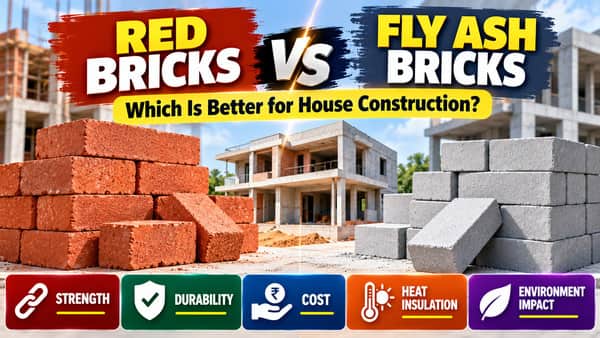
The final choice should therefore be based on tested quality, local availability and the structural engineer’s specifications—not simply the colour or name of the brick.
Red Bricks vs Fly Ash Bricks: Quick Comparison
| Factor | Red Bricks | Fly Ash Bricks |
|---|---|---|
| Main materials | Natural clay | Fly ash with lime/cement and other permitted ingredients |
| Manufacturing | Generally kiln-fired | Usually moulded/pressed and cured |
| Shape and size | Can vary more between local manufacturers | Generally more uniform when well manufactured |
| Weight | Usually relatively heavier | Often comparatively lighter, depending on product |
| Surface | Rougher | Usually smoother and more uniform |
| Mortar requirement | Can be higher with irregular bricks | Can be lower with accurate dimensions |
| Plaster requirement | Usually higher if surfaces are uneven | Can be lower with good-quality uniform bricks |
| Water absorption | Depends strongly on brick class and quality | Generally controlled when manufactured to standard |
| Environmental consideration | Uses clay and requires firing | Utilises fly ash, an industrial by-product |
| Availability | Excellent across most of India | Better in cities and areas near manufacturers |
| Familiarity among masons | Very high | High in many urban markets |
| Best suited for | Traditional and general construction | Modern RCC-framed buildings and partitions |
What Are Red Bricks?
Red bricks are traditional burnt-clay masonry units. Clay is moulded into the required shape, dried and fired to develop strength and durability.
They have been used extensively in Indian construction for generations.
BIS now lists IS 1077:2025 – Common Burnt Clay Building Bricks – Specification (Sixth Revision) as the current Indian Standard, superseding IS 1077:1992.
Advantages of Red Bricks
- Long history of use in Indian buildings
- Widely available
- Familiar to local contractors and masons
- Available in different strength classes
- Good-quality products can be strong and durable
- Rough surfaces can provide good bonding with conventional mortar and plaster
- Easy to source in many smaller towns and rural areas
One of their biggest advantages is availability. In many locations, a nearby brick kiln can make red bricks cheaper to transport than factory-produced alternatives coming from farther away.
Their biggest weakness is variation in quality.
Locally produced bricks can vary in dimensions, firing quality, strength and water absorption. This is why selecting bricks based only on appearance is risky.
BIS material guidance notes that common burnt-clay solid bricks are widely used for building and civil-engineering construction and are classified according to their properties.
What Are Fly Ash Bricks?
Fly ash bricks use fly ash—an industrial by-product—as an important raw material. Depending on the type, it is combined with materials such as lime or cement and other permitted ingredients before being formed into bricks.
BIS maintains IS 12894:2002 for pulverized fuel ash-lime bricks. The standard establishes requirements covering classification, quality, dimensions and physical properties for bricks used in buildings.
Advantages of Fly Ash Bricks
- More uniform shape when properly manufactured
- Smooth surfaces
- Efficient wall construction
- Potentially lower mortar consumption
- Can reduce plaster requirements
- Utilise an industrial by-product
- Available in multiple strength classes
- Good dimensional accuracy from reputable manufacturers
BIS specifically describes fly ash-lime bricks as an alternative that makes use of industrial by-products and can have a lower environmental footprint than conventional clay bricks.
Their uniform dimensions can also produce straighter masonry.
If every brick is close to the intended dimensions, masons do not have to compensate for large variations with thick mortar joints.
Which Is Stronger: Red Brick or Fly Ash Brick?
There is no reliable answer based solely on brick type.
Strength depends on the class and quality of the actual product.
BIS recognises multiple strength classes for both traditional and fly ash-based masonry products. BIS laboratory information for IS 12894, for example, lists fly ash-lime brick classes from 3.5 through 30, while burnt-clay brick standards also classify products according to compressive strength.
This means statements such as “fly ash bricks are always stronger than red bricks” are too simplistic.
A high-quality red brick can be stronger than a low-grade fly ash brick. A properly manufactured higher-strength fly ash brick can outperform a poor-quality locally fired clay brick.
For a house, the engineer should specify the required masonry strength, after which bricks should be purchased accordingly.
Which Brick Absorbs Less Water?
Water absorption is an important quality parameter because excessive absorption can affect masonry behaviour and construction.
Both red-brick and fly ash-brick standards include water-absorption testing requirements. BIS laboratory testing for IS 1077 includes compressive strength, water absorption and efflorescence, while IS 12894 testing similarly covers compressive strength, drying shrinkage, efflorescence and water absorption.
Well-manufactured fly ash bricks commonly provide consistent water behaviour because manufacturing conditions and dimensions can be closely controlled.
But homeowners should avoid judging an entire category from one sample.
Request test information for the batch being supplied where quality is important.
Which Requires Less Mortar?
This is one area where well-made fly ash bricks can offer a practical construction advantage.
Because factory-produced fly ash bricks can have more consistent dimensions and straighter edges, masonry joints can be more uniform.
Traditional red bricks from smaller kilns sometimes show greater dimensional variation.
If one brick is slightly thicker and another thinner, the mason has to compensate with mortar. Across thousands of bricks, that difference can increase material and labour consumption.
However, good-quality dimensionally accurate burnt-clay bricks can also produce efficient masonry.
Therefore, the real comparison is:
uniform brick vs irregular brick, not simply fly ash vs red.
Which Requires Less Plaster?
Fly ash bricks generally have a smoother, more consistent surface.
Straight masonry can require less corrective plaster to achieve a level finished wall.
Red bricks commonly have rougher surfaces and can vary more in shape, particularly with locally manufactured products.
That does not mean a fly ash wall can automatically be left without plaster.
Plaster requirements depend on architectural design, workmanship, weather exposure, moisture protection and the finish required.
The potential saving comes from needing less material to correct uneven masonry.
Thermal Performance: Which Keeps the House Cooler?
This comparison needs caution because the thermal performance of a house is not determined by bricks alone.
Wall thickness, brick density, cavities, plaster, insulation, windows, roof design, orientation and shading can have a much larger effect on indoor temperature.
BIS building-material guidance notes good thermal properties for fly ash-lime bricks and identifies improved thermal characteristics for some fly ash-containing brick products.
However, it would be misleading to promise that simply replacing red bricks with fly ash bricks will automatically make a house substantially cooler.
For hot Indian climates, roof insulation, shaded windows, appropriate glazing and wall design should be considered alongside masonry selection.
Which Is More Environmentally Friendly?
Fly ash bricks have a significant advantage in their use of industrial by-products.
Fly ash is generated from coal combustion. Incorporating it into masonry products can put this material to productive use while reducing demand for natural clay.
BIS has highlighted IS 12894 fly ash-lime bricks as an eco-friendlier alternative to conventional clay bricks because they utilise industrial by-products and have a lower environmental footprint.
Traditional red-brick manufacturing requires clay extraction and firing.
However, environmental performance still varies between manufacturers. Raw-material sourcing, manufacturing energy, transport distance and production technology all matter.
A fly ash brick transported hundreds of kilometres, for example, carries transportation impacts that a locally sourced product may avoid.
Which Is Cheaper for House Construction?
Do not compare only the price per brick.
Calculate the finished wall cost.
Suppose one red brick costs less than one fly ash brick. Red brick may initially appear cheaper.
But the calculation can change after considering:
- Number of bricks required
- Transportation
- Loading and unloading
- Breakage
- Mortar
- Plaster
- Labour
- Water usage during construction
- Wastage
Uniform fly ash bricks can sometimes compensate for a higher unit price through reduced mortar, plaster and wastage.
In another city, locally manufactured red bricks may remain more economical because transportation costs for fly ash bricks are high.
For this reason, there is no reliable all-India answer to which brick is cheaper.
Ask suppliers for delivered prices and have the contractor calculate the masonry cost per square metre or cubic metre instead of comparing only the price per brick.
Red Bricks vs Fly Ash Bricks for Load-Bearing Houses
Brick selection becomes more critical when the masonry itself carries structural loads.
In a load-bearing house, walls transfer loads from floors and roofs down to the foundation.
The required compressive strength and other masonry properties should therefore be specified by a structural engineer.
Do not replace the specified masonry unit simply because another brick is cheaper.
Both categories can contain products with different strength classifications. BIS standards specifically recognise compressive-strength testing as a key requirement.
Which Is Better for an RCC-Framed House?
In an RCC-framed building, reinforced-concrete columns and beams form the principal structural frame, while brickwork commonly functions as infill or partition masonry.
For this type of construction, good-quality fly ash bricks can be an excellent option.
Their dimensional consistency can help with:
- Faster masonry
- Straighter walls
- Consistent joints
- Reduced mortar consumption
- Reduced corrective plaster
- Lower wastage
But the word good-quality is essential.
Cheap fly ash bricks from an unreliable manufacturer should not be selected merely because the material category sounds modern or sustainable.
What to Check Before Buying Bricks
The safest purchasing approach is to compare actual batches rather than accepting a salesperson’s claims about an entire brick category.
For red clay bricks, check that the product conforms to the appropriate current specification; BIS lists IS 1077:2025 for common burnt-clay building bricks.
For pulverized fuel ash-lime bricks, check applicable conformity with IS 12894:2002 and its amendments.
Ask for test results covering important properties such as compressive strength and water absorption.
Also physically inspect several bricks from different parts of the delivered batch. Look for major dimensional variations, cracks, damaged edges and inconsistent quality.
For an important residential project, laboratory testing of representative samples provides much stronger evidence than informal tests performed at the construction site.
Red Brick or Fly Ash Brick: Which Should You Choose?
For a typical modern RCC-framed house, high-quality fly ash bricks are often the better practical choice when a reliable local manufacturer is available.
They can provide excellent dimensional consistency, efficient masonry and productive utilisation of fly ash.
Choose fly ash bricks when reliable standard-compliant products are locally available, consistent dimensions are important and the contractor has experience working with them.
Choose red bricks when high-quality burnt-clay bricks are readily available locally, transport makes alternative bricks expensive, or the project’s engineer has specifically designed the masonry around them.
For a load-bearing house, do not make the decision from a generic online comparison. Follow the structural design and required brick strength.
Most importantly, do not buy an inferior brick of either type to save a small amount of money. The quality of the actual masonry unit and workmanship can matter more than whether the brick is red or grey.
FAQs
Q1. Which is better for house construction, red brick or fly ash brick?
A. For many modern RCC-framed houses, good-quality fly ash bricks can be a practical choice because of their dimensional consistency and efficient use in masonry. High-quality red bricks are also durable and suitable for house construction. The required strength and actual product quality should guide the final decision.
Q2. Are fly ash bricks stronger than red bricks?
A. Not automatically. Both brick types are available in different strength classes. BIS standards use compressive-strength testing for both categories, so compare the specified and tested strength of the actual bricks rather than assuming one material is always stronger.
Q3. Which bricks require less cement mortar?
A. Well-manufactured fly ash bricks can require less corrective mortar because their dimensions and surfaces are generally more uniform. Actual mortar consumption still depends on brick dimensions, joint thickness, workmanship and wall design.
Q4. Are fly ash bricks suitable for load-bearing walls?
A. Fly ash bricks are produced in multiple strength classes and can be used where the selected masonry unit satisfies the structural design and applicable requirements. For a load-bearing house, the required brick class and masonry design should be specified by the structural engineer. IS 12894 covers fly ash-lime bricks in multiple strength classifications.
Q5. Which brick is more eco-friendly?
A. Fly ash bricks generally have an environmental advantage because they utilise fly ash, an industrial by-product, and can reduce demand for natural clay. BIS materials on green construction specifically highlight this benefit of fly ash-based bricks.