Exterior paint has a harder job than interior paint. During a single year, the same wall may face intense summer sunlight, monsoon rain, dust, humidity and repeated heating and cooling. A coating that looks economical on painting day may therefore become expensive if it fades or needs repainting much sooner.
This is the practical difference between cement paint and exterior emulsion paint.
Cement paint remains a budget-friendly coating for masonry and concrete surfaces. Exterior emulsion costs more but generally provides better colour choice, weather resistance, finish and durability. Even paint manufacturers describe cement paint as economical for exteriors but more limited in durability and shades than emulsions.
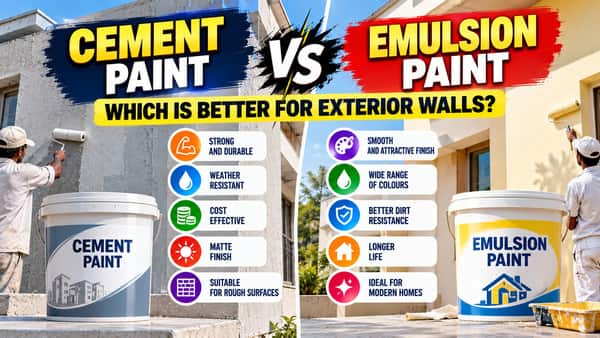
For most modern Indian homes where appearance and longer-term exterior performance matter, a good-quality exterior emulsion is generally the better choice.
Cement Paint vs Emulsion Paint: Quick Comparison
| Factor | Cement Paint | Exterior Emulsion Paint |
|---|---|---|
| Basic type | Cement-based coating | Water-based polymer/emulsion coating |
| Initial cost | Lower | Higher |
| Exterior use | Yes | Yes |
| Finish | More basic/matt | Smoother and more refined |
| Colour options | More limited | Extensive |
| Weather resistance | Basic protection | Generally better |
| UV resistance | Limited compared with premium emulsions | Better in quality exterior products |
| Colour retention | Lower | Generally better |
| Water resistance | Moderate/product-dependent | Better in weatherproof formulations |
| Flexibility | Relatively rigid | Polymer film offers better flexibility |
| Surface preparation | Important | Very important |
| Repainting interval | Generally shorter | Generally longer for quality systems |
| Best for | Budget exterior work | Modern residential exterior walls |
What Is Cement Paint?
Cement paint is a cement-based decorative and protective coating designed primarily for masonry and concrete surfaces.
Unlike conventional liquid emulsion paint, traditional cement paint is generally supplied as a powder and prepared with water according to the product instructions before application.
The Bureau of Indian Standards covers cement paint under IS 5410:2013 – Cement Paint – Specification (Second Revision). BIS records show that this standard was reviewed in 2026.
BIS also describes IS 5410 as specifying requirements for cement-based paints used on concrete and masonry surfaces, including their properties and performance.
Advantages of Cement Paint
- Relatively economical
- Suitable for masonry surfaces
- Can be applied to cement plaster
- Useful for basic exterior finishing
- Cementitious nature suits mineral substrates
- Available widely in the Indian market
- Practical for budget-sensitive construction
Cement paint was widely used on Indian exterior walls before modern acrylic and other polymer-based exterior coatings became common.
It remains useful where the primary objective is obtaining an economical coloured exterior coating rather than a premium finish.
Best for: Low-budget exterior painting where basic appearance and protection are sufficient.
What Is Exterior Emulsion Paint?
Exterior emulsion is a water-based decorative coating formulated specifically for surfaces exposed to outdoor conditions.
Modern exterior emulsions generally use polymer binders that form a continuous film after the water evaporates.
Different product categories may include acrylic and other modified polymer technologies.
Exterior paints can be formulated to provide resistance against:
- Rain
- Sunlight
- UV exposure
- Fungal or algal growth
- Dirt
- Humidity
- Colour fading
The exact protection varies considerably by product.
Asian Paints, for example, advises that weatherproof and UV-resistant coatings are preferable for Indian exterior conditions and notes that good exterior paints can provide water resistance and fading resistance.
Best for: Residential exterior walls where appearance, colour retention and longer-lasting weather protection are priorities.
Which Lasts Longer?
Exterior emulsion generally has the advantage.
Traditional cement paint provides an economical exterior finish, but its durability and colour-retention performance are more limited than those of modern quality exterior emulsions.
Current manufacturer guidance explicitly identifies economy as a benefit of cement paint while noting its limitations in durability and shade availability compared with emulsions.
A quality exterior emulsion forms a polymer-based coating designed to tolerate outdoor weather.
The actual service life, however, depends heavily on:
- Product quality
- Surface preparation
- Number of coats
- Wall condition
- Moisture exposure
- Climate
- Application quality
A premium coating applied over a damp or badly prepared wall can fail earlier than an inexpensive coating applied correctly.
Which Handles Indian Weather Better?
For demanding exterior exposure, quality exterior emulsion generally performs better.
Indian homes can face dramatically different conditions depending on location.
Delhi and northern cities experience strong summer heat and seasonal rain. Coastal cities deal with high humidity and heavy monsoons. Other regions may face intense sunlight for much of the year.
Modern exterior emulsions can be formulated specifically to address UV exposure, rain and fungal growth.
Asian Paints recommends weatherproof and UV-resistant coatings for Indian weather and moisture/anti-fungal performance for high-humidity locations.
Cement paint can still be used outdoors, but it does not provide the same range of specialised performance options.
Which Provides Better Water Resistance?
Exterior emulsion generally wins, provided a suitable weather-resistant product is selected.
Many modern exterior emulsions are designed to resist rainwater penetration at the surface.
But there is an important limitation:
Exterior paint is not automatically a complete waterproofing system.
If a wall has cracks, failed terrace waterproofing, leaking plumbing or another source of persistent water ingress, applying expensive exterior emulsion over it does not solve the underlying defect.
Moisture can eventually push coatings away from the substrate and cause:
- Blistering
- Peeling
- Damp patches
- Efflorescence
- Fungal growth
Repair water-entry problems before repainting.
Which Is Better for Colour Retention?
Exterior emulsion generally performs better.
Cement paint is available in different colours, but its shade range and long-term colour performance tend to be more limited.
Exterior emulsions are available in a much broader colour palette and higher-performance products are designed to resist fading from sunlight and UV exposure.
This matters particularly on:
- South- and west-facing walls
- Parapets
- Boundary walls
- Tall exposed façades
- Buildings with dark exterior colours
UV resistance varies between products, so do not assume every exterior emulsion provides identical fade resistance.
Which Gives a Better Finish?
Exterior emulsion usually provides a more refined appearance.
Cement paint commonly produces a basic matt mineral finish.
That can be perfectly acceptable for:
- Boundary walls
- Utility buildings
- Low-cost construction
- Rural properties
- Large surfaces where economy matters
Exterior emulsion provides greater choice in appearance and generally creates a more uniform decorative finish.
For a modern independent house where façade appearance contributes significantly to the overall design, emulsion usually offers more flexibility.
Which Has More Colour Options?
Exterior emulsion clearly has the advantage.
Modern paint systems offer extensive colour ranges, including subtle neutrals and stronger architectural colours.
Cement paints traditionally have fewer shade choices.
This may not matter for a basic white or simple pastel exterior, but it becomes important when an elevation combines several shades or the homeowner wants a specific architectural colour scheme.
Current paint-industry guidance similarly identifies limited shade options as one of cement paint’s disadvantages compared with emulsion.
Which Is Better for Exterior Cement Plaster?
Both can be used on appropriate cementitious exterior surfaces when the substrate is correctly prepared and the selected product permits it.
Cement paint naturally works with masonry and cement-plastered backgrounds. BIS describes cement paint under IS 5410 as a coating for concrete and masonry surfaces.
Exterior emulsion is also commonly applied to cement-plastered exterior walls as part of an appropriate primer-and-paint system.
The surface must be adequately cured before painting.
Painting fresh cement plaster too early can cause problems because moisture and alkalinity are still present in the substrate.
Follow the coating manufacturer’s specified waiting period rather than rushing exterior painting immediately after plastering.
Does Exterior Emulsion Need Primer?
Normally, a compatible primer forms part of the recommended system for new exterior walls.
Primer helps create a suitable base for the decorative coating and can improve adhesion and uniformity.
Asian Paints states in its exterior guidance that primer improves adhesion and contributes to a longer-lasting finish.
The correct system can vary between products, however.
Some systems may involve:
Exterior plaster → suitable putty where required → exterior primer → exterior emulsion
Others may specify a different sequence.
Follow the technical data for the specific product rather than assuming that one painting sequence applies to every brand and wall condition.
What About Cracks Before Exterior Painting?
Do not simply paint over visible cracks.
Exterior walls constantly experience temperature changes. Small cracks can also provide routes for rainwater.
Before painting, determine whether the crack is:
- A superficial plaster crack
- A junction crack
- A deeper masonry crack
- An active structural crack
Minor non-moving defects can be repaired with a suitable exterior repair material.
Repeated, widening or significant cracks should be assessed properly before decorative coatings are applied.
Exterior emulsion can have greater film flexibility than cement paint, but normal paint should never be expected to bridge serious structural movement.
Cement Paint vs Emulsion Paint for Damp Walls
Neither should be used as a shortcut for solving dampness.
First identify where the water comes from.
Possible sources include:
- Exterior cracks
- Roof leakage
- Parapet leakage
- Plumbing
- Poor window sealing
- Failed waterproofing
- Ground moisture
After repairing the source, allow the wall to reach the condition specified by the coating manufacturer before repainting.
Applying multiple coats over an actively damp wall may only hide the problem temporarily.
Which Is Easier to Apply?
Modern exterior emulsion is generally more convenient as a painting system because it is supplied as a formulated liquid coating, though dilution and application requirements vary.
Traditional cement paint is supplied as powder and requires correct mixing with water.
Its cementitious nature also makes correct preparation and application important.
BIS’s current amendment guidance for IS 5410 illustrates that cement paint mixed with water begins to thicken through the setting process, which is fundamentally different from simply opening and applying a conventional liquid coating.
Professional application is beneficial for both systems, especially on large exterior façades where uneven coverage is highly visible.
Cement Paint vs Emulsion Paint Cost
Cement paint usually wins on initial material cost.
That is its primary attraction.
Suppose a homeowner wants to finish a large boundary wall or rental property at the lowest practical upfront cost. Cement paint may be perfectly reasonable.
Exterior emulsion costs more initially, especially as the product moves from economy to premium weatherproof categories.
But the calculation should include repainting.
Consider:
Initial painting cost + maintenance + repainting frequency
rather than only:
Price per litre or kilogram
A coating that costs less today but needs significantly more frequent repainting may not be cheaper over a long period.
Which Is Better for Boundary Walls?
Both can make sense.
Choose cement paint when the boundary wall is large, the budget is limited and a simple finish is acceptable.
Choose exterior emulsion when the boundary wall is an important visual part of the house and better colour retention, weather performance and finish are desired.
The wall cap should also be designed to prevent excessive rainwater penetration from the top.
No decorative coating can compensate indefinitely for poor construction detailing.
Which Is Better for Coastal Areas?
A quality exterior emulsion designed for high humidity is generally the better option.
Coastal buildings face challenging conditions including humidity, rain and biological growth.
Exterior coatings with appropriate moisture and anti-fungal performance are preferable in these environments. Current exterior-paint guidance specifically recommends anti-fungal and moisture-resistant coatings for coastal or high-humidity areas.
Surface preparation becomes particularly important because existing fungal or algal growth should be treated before repainting.
Which Is More Suitable for a Modern House?
For the main exterior elevation of a modern Indian house, exterior emulsion is generally the better investment.
It provides:
- Better weather performance
- Wider colour choice
- Better colour retention
- More refined appearance
- Greater product choice
- Better options for UV and moisture resistance
- Potentially longer repainting cycles
Cement paint remains useful where economy is the main objective.
This means it has not become useless simply because newer coatings exist.
It is a different value proposition.
Cement Paint or Exterior Emulsion: Which Should You Choose?
Choose cement paint when:
- The budget is very limited
- The wall area is large
- A basic matt finish is acceptable
- Shorter repainting cycles are acceptable
- The property is utility-oriented rather than appearance-focused
Choose exterior emulsion when:
- Painting your primary residence
- Long-term exterior appearance matters
- You want more colour options
- The façade receives strong sunlight
- Better weather resistance is important
- Better colour retention is desired
- You prefer longer intervals between major repainting
For the main façade and exposed exterior walls of most modern Indian homes, good-quality exterior emulsion is generally the better overall choice.
For secondary walls, boundary walls or highly budget-sensitive construction, cement paint can still be an economical solution.
Whichever system is chosen, correct surface preparation matters enormously. Repair cracks and water-entry problems first, prepare and prime the surface as required, and apply the coating only under suitable weather conditions.
Spending more on paint cannot compensate for a wall that was not properly prepared.
FAQs
Q1. Which is better for exterior walls, cement paint or emulsion paint?
A. Exterior emulsion is generally better for modern homes because it provides greater weather resistance, more colour options and better long-term appearance. Cement paint is more economical but has comparatively limited durability and shade choice.
Q2. Is cement paint waterproof?
A. Cement paint provides a protective coating for masonry and concrete, but it should not be treated as a complete waterproofing system. Active leakage, significant cracks and failed waterproofing should be repaired separately before painting.
Q3. Does exterior emulsion protect walls from rain?
A. Many quality exterior emulsions are formulated to provide water and weather resistance. Their performance depends on the particular product, correct surface preparation and application. Exterior-paint guidance recommends weather-resistant coatings for exposed Indian conditions.
Q4. Is cement paint cheaper than exterior emulsion?
A. Cement paint is generally cheaper initially and remains useful for budget exterior work. Exterior emulsion costs more but can provide better durability and appearance, so long-term repainting costs should also be considered.
Q5. Which paint is best for the exterior of an Indian house?
A. For most modern Indian homes, a quality exterior emulsion suited to the local climate is generally preferable. Look for appropriate UV, weather, moisture and fungal resistance rather than choosing solely by price. Cement paint remains a practical alternative where keeping the initial cost low is the main priority.