The last few millimetres of a wall can determine how expensive paint eventually looks. Even premium emulsion cannot completely hide pores, minor undulations, hairline surface defects or inconsistent absorption underneath it. This is why preparing the wall properly before opening the paint bucket matters.
Two materials commonly discussed at this stage in Indian construction are white cement and wall putty. They are related, but they are not the same product.
For most properly plastered walls, wall putty is the better choice before painting because it is specifically formulated to create a smooth, uniform paint-ready surface. White cement is a cementitious material with broader construction and decorative uses and can also be an important ingredient in cement-based wall putty.
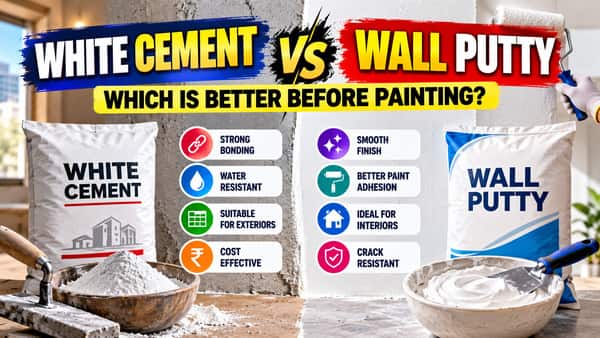
White Cement vs Wall Putty: Quick Comparison
| Factor | White Cement | Wall Putty |
|---|---|---|
| What it is | White-coloured Portland cement | Formulated wall-finishing material |
| Main purpose | Construction, architectural and decorative applications | Surface preparation before painting |
| Common composition | Cementitious binder | White cement/polymer/acrylic-based formulation depending on product |
| Surface smoothing | Possible but not its only purpose | Specifically designed for it |
| Filling fine pores | Limited compared with formulated putty | Excellent |
| Paint-ready finish | May need additional preparation | Designed for paint preparation |
| Adhesion | Strong cementitious bonding | Formulated for wall and paint systems |
| Moisture resistance | Good cementitious characteristics | Good in suitable white cement-based products |
| Interior walls | Can be used | Excellent |
| Exterior walls | Suitable in appropriate applications | Certain exterior-grade putties are suitable |
| Best before painting | Not normally the first choice alone | Usually the better choice |
What Is White Cement?
White cement is a type of Portland cement manufactured to achieve a high degree of whiteness while retaining cementitious properties.
Its colour is achieved through careful control of raw materials and manufacturing, particularly components that would otherwise produce the grey colour associated with ordinary Portland cement.
In India, white Portland cement is covered by IS 8042:2015. BIS specifies requirements covering properties including fineness, setting time, compressive strength, soundness and whiteness.
Common Uses of White Cement
- Architectural finishes
- Decorative concrete
- Tile-related applications
- Terrazzo
- Precast decorative elements
- Coloured cement work
- Repairs and finishing
- Production of white cement-based putty
White cement therefore has a much broader role than merely preparing a bedroom wall for paint.
Best for: Cementitious decorative and architectural applications and as a base material in formulated finishing products.
What Is Wall Putty?
Wall putty is a fine finishing material formulated specifically to prepare walls for painting.
It fills small surface pores and minor imperfections while helping create a smoother and more consistent substrate.
There are different kinds of putty.
Common Wall Putty Types
- White cement-based putty
- Acrylic putty
- Polymer-modified cement putty
- Gypsum-based finishing products
White cement-based putty is particularly popular in Indian construction.
This is where the comparison can become confusing: white cement can be an ingredient in wall putty, but a bag of white cement and a bag of formulated wall putty are not necessarily interchangeable products.
For example, JK Cement describes its cement-based wall putty as a product containing white cement, polymers and minerals designed specifically for wall preparation.
Best for: Preparing plastered interior or suitable exterior walls before the paint system is applied.
Why Wall Putty Is Usually Better Before Painting
A material designed for one specific stage of construction usually has advantages when used for that stage.
Wall putty is formulated to create a suitable surface for subsequent coatings.
Its fine particle structure and additives can help:
- Fill small pores
- Correct minor surface imperfections
- Improve surface smoothness
- Provide more uniform paint absorption
- Improve the appearance of the final finish
- Provide an appropriate base for subsequent primer/paint systems
White cement itself provides cementitious binding and whiteness but does not automatically contain all the additives included in a formulated wall putty.
Using plain white cement simply because it looks similar to white cement-based putty therefore misses an important difference in formulation.
Is Wall Putty Made From White Cement?
Some wall putties are; others are not.
Many widely used Indian powdered wall putties use white cement as their primary binder, combined with polymers, fillers and other additives.
Birla White, for example, markets WallCare Putty as a white cement-based putty designed to provide a smooth protective base for paint.
Other products can be acrylic or based on different formulations.
Therefore:
White cement = raw cementitious material/product.
White cement-based wall putty = formulated finishing product containing white cement plus other ingredients.
This is why purchasing white cement alone is not necessarily equivalent to purchasing wall putty.
Which Gives a Smoother Wall?
Wall putty generally wins when the purpose is final wall preparation.
Putty is designed to fill small pores and surface irregularities.
It can be applied in controlled thin coats and finished to produce a smooth surface suitable for paint.
White cement can produce attractive finishes in its own right, but it is not automatically formulated to provide the same fine levelling and paint-preparation properties as a dedicated putty.
The quality of the underlying plaster still matters.
Putty should not be expected to repair badly uneven masonry or thick plaster defects.
Can Wall Putty Correct an Uneven Wall?
Only to a limited extent.
This is one of the most common mistakes during house finishing.
If a wall has small pores and minor surface irregularities, putty is appropriate.
If a wall is significantly wavy, out of plumb or contains deep depressions, attempting to straighten it using thick layers of putty can waste material and exceed the product’s recommended application thickness.
The underlying plaster should be corrected first.
Think of wall preparation in three levels:
Major unevenness → correct plaster
Minor imperfections → wall putty
Final appearance → primer and paint system
Trying to make one material perform all three jobs usually increases cost and reduces quality.
Which Is Better for Interior Walls?
For ordinary painted interior walls, wall putty is generally the better choice.
Bedrooms, living rooms, corridors and other dry interior spaces usually need a smooth and uniform substrate before decorative paint.
A suitable wall putty is specifically intended for this purpose.
White cement may still appear elsewhere in the construction process or as an ingredient within the putty itself.
There is usually little reason to replace a properly formulated wall putty with plain white cement solely for interior paint preparation.
Which Is Better for Exterior Walls?
The answer depends on the specific product.
White cement has good cementitious characteristics and is widely used in architectural and exterior applications.
Certain white cement-based exterior wall putties are also formulated specifically for external surfaces.
For example, current manufacturer information from Asian Paints identifies its TruCare Wall Putty as a white cement-based product suitable for interior and exterior application.
But not every wall putty is suitable outside.
An acrylic interior putty should not automatically be substituted for an exterior-grade cement-based product.
Always check whether the particular putty is labelled and specified for exterior use.
Which Is Better for Damp Walls?
Neither should be used to hide an active dampness problem.
If water is entering through an external wall, leaking pipe, bathroom or roof, adding another layer of white cement or putty does not remove the source.
Eventually, moisture can cause problems such as:
- Paint peeling
- Blistering
- Staining
- Efflorescence
- Surface deterioration
- Fungal growth
A suitable white cement-based putty can offer moisture resistance, but moisture resistance is not the same as waterproofing.
The leakage or waterproofing defect should be repaired first.
Then the wall should be allowed to reach the appropriate condition before the specified finishing system is applied.
White Cement vs Wall Putty for Cracks
Neither is the universal solution for cracks.
Tiny non-moving surface imperfections may be corrected during normal wall preparation.
But a crack that extends through the plaster or repeatedly reappears requires investigation.
Possible causes include movement at RCC-masonry junctions, plaster shrinkage, structural movement, thermal movement or improperly treated service chases.
Simply filling an active crack with putty may hide it temporarily without solving the underlying problem.
Larger or moving cracks need an appropriate repair system before final finishing.
Does Wall Putty Reduce Paint Consumption?
A well-prepared wall can make paint application more uniform.
Raw plaster can contain pores and areas with different absorption characteristics. Putty helps create a smoother and more consistent substrate.
This can improve the appearance and efficiency of subsequent coatings.
However, claims that putty always saves a specific percentage of paint should be treated cautiously because actual consumption depends on:
- Surface condition
- Putty thickness
- Primer
- Paint type
- Number of coats
- Application method
- Desired finish
The safest approach is to follow the coverage specifications of the selected putty, primer and paint products.
Is Primer Needed After Wall Putty?
This depends on the complete paint system recommended by the manufacturer.
Putty and primer have different functions.
Putty primarily corrects small surface imperfections and smooths the wall.
Primer helps prepare the substrate for the decorative topcoat and can improve adhesion and uniformity.
BIS maintains IS 2395 for painting concrete, masonry and plaster surfaces, covering preparation and painting practices for these substrates.
Do not assume that using putty automatically eliminates every other preparation stage.
Follow the specified sequence for the particular paint system.
What Is the Correct Sequence Before Painting?
There is no single sequence for every product, but a typical new cement-plastered interior wall may involve:
Masonry → Cement plaster → Surface preparation → Putty → Appropriate primer → Paint
Some paint systems specify a primer before putty or have different requirements for new and previously painted surfaces.
The manufacturer’s instructions should therefore take priority over a generic sequence.
The plaster should also be adequately cured and in suitable condition before finishing begins.
Applying putty or paint prematurely over damp cement plaster can create later problems.
Can White Cement Be Mixed With Paint?
White cement is used in various decorative cement applications, but it should not be casually mixed into modern emulsion paint unless the coating system specifically permits it.
Paint products are formulated with particular ratios of binders, pigments, fillers and additives.
Adding construction materials on site can change:
- Adhesion
- Colour
- Consistency
- Drying
- Durability
- Surface finish
Use white cement for applications for which it is designed and use paint according to the coating manufacturer’s specifications.
White Cement vs Wall Putty Cost
Plain white cement may appear cheaper when comparing only the price per kilogram.
But that is not a fair measure if the objective is a paint-ready wall.
A proper comparison should include:
- Material consumption per square metre
- Number of coats
- Labour
- Surface levelling
- Sanding
- Primer requirements
- Paint consumption
- Final finish quality
Wall putty costs more because it is a formulated product rather than simply a basic cementitious binder.
But those additional ingredients are precisely why it is more appropriate for fine wall preparation.
The aim should be the lowest cost for the required finished surface, rather than the cheapest bag.
White Cement vs POP vs Wall Putty
These three materials are often confused during interior finishing.
| Material | Primary Job |
|---|---|
| White cement | Cementitious/architectural material and putty base |
| POP | Gypsum-based levelling and decorative work |
| Wall putty | Fine surface preparation before painting |
If a cement-plastered wall is already reasonably straight, wall putty may be all that is required before the appropriate primer and paint system.
If substantial dry-interior levelling or decorative moulding is required, POP or another suitable gypsum plaster can perform that job.
White cement may be used directly for certain architectural applications or as the key binder in a white cement-based putty.
They should therefore be selected according to function rather than appearance.
White Cement or Wall Putty: Which Should You Use Before Painting?
For most normal Indian home walls, wall putty is the better material before painting.
Choose a suitable wall putty when the objective is to:
- Fill fine pores
- Correct minor imperfections
- Produce a smooth surface
- Prepare walls for decorative paint
- Create a more uniform substrate
Use white cement when the construction or architectural application specifically calls for white cement, or use a formulated white cement-based putty when you want the advantages of white cement in a dedicated wall-finishing product.
If the wall is substantially uneven, repair the underlying plaster instead of trying to straighten everything with putty.
If the wall is damp, repair the source of moisture before applying either material.
The simplest distinction is:
White cement is a building material. Wall putty is a wall-preparation product.
For a smooth painted wall, the formulated product designed for surface preparation is usually the more appropriate choice.
FAQs
Q1. Which is better before painting, white cement or wall putty?
A. Wall putty is generally better because it is specifically formulated to fill small pores and imperfections and create a smooth surface for painting. White cement is a broader cementitious material and is also commonly used as a key ingredient in cement-based wall putties.
Q2. Is wall putty the same as white cement?
A. No. White cement is a type of Portland cement, while wall putty is a formulated finishing material. Many Indian powdered wall putties contain white cement together with polymers, minerals and other additives.
Q3. Can I apply white cement instead of wall putty?
A. White cement can be used for suitable cementitious and decorative applications, but it is not a direct replacement for formulated wall putty when the objective is fine surface preparation before painting. Putty is specifically designed for that purpose.
Q4. Can wall putty stop wall dampness?
A. No. Some cement-based putties have good moisture resistance, but wall putty is not a substitute for waterproofing. Plumbing leaks, seepage, rising damp or failed exterior waterproofing should be repaired before the wall is refinished.
Q5. Is white cement-based putty good for exterior walls?
A. Yes, provided the particular product is specifically approved for exterior use. Several white cement-based putties are formulated for both interior and exterior surfaces, but product specifications should always be checked before application.