When a newly plastered wall looks uneven, the natural reaction is to ask which finishing material will make it perfectly smooth. But the answer depends on the size of the imperfections. Tiny pores and minor surface irregularities need a very different treatment from a wall that is visibly wavy or requires decorative moulding.
That distinction explains the difference between wall putty and Plaster of Paris (POP).
For most interior walls being prepared for paint, wall putty is the better final surface-preparation material. POP is more useful when deeper levelling, ceiling work, cornices, decorative features or gypsum-based repairs are required.
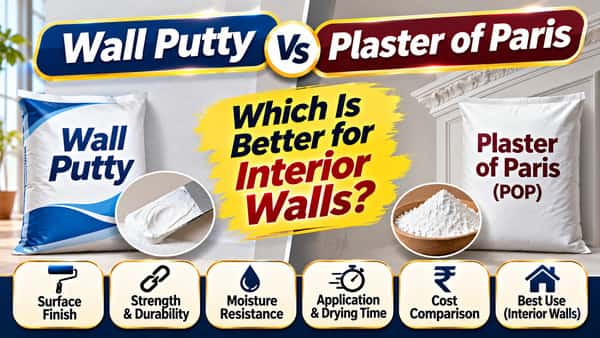
In many Indian homes, the two can even be used at different stages rather than treated as competing products.
Wall Putty vs POP: Quick Comparison
| Factor | Wall Putty | Plaster of Paris (POP) |
|---|---|---|
| Primary purpose | Paint surface preparation | Levelling, plastering and decorative work |
| Common base | White cement or acrylic/polymer systems | Gypsum |
| Application thickness | Thin | Can be applied thicker depending on system |
| Surface finish | Very smooth | Smooth |
| Best location | Walls before painting | Interior walls and ceilings |
| Exterior suitability | Some cement-based products are suitable | Generally unsuitable |
| Moisture resistance | Better with cement-based putty | Poor for persistent dampness |
| Decorative moulding | Not suitable | Excellent |
| False ceilings | Not normally used | Commonly used in related gypsum work |
| Wall levelling | Minor irregularities | Better for larger corrections |
| Paint preparation | Excellent | May still need further preparation |
| Setting | Product dependent | Relatively fast |
| Best use | Final paint-ready surface | Interior levelling and decorative work |
What Is Wall Putty?
Wall putty is a fine finishing material applied to plastered or otherwise suitably prepared walls before painting.
Its main purpose is to fill small pores, minor imperfections and surface irregularities while creating a smooth, consistent substrate for the paint system.
Several types are available in India.
Common Types of Wall Putty
- White cement-based putty
- Acrylic putty
- Polymer-modified putty
- Gypsum-based finishing products
White cement-based putty is particularly common in Indian construction.
JK Cement describes white cement-based wall putty as a strong, well-bonded option that handles moisture better than basic interior alternatives and can be used on interior as well as suitable exterior walls.
Acrylic putties, by comparison, are generally intended for interior finishing and are often supplied ready to use.
Best for: Preparing an already reasonably level wall for primer and paint.
What Is Plaster of Paris?
Plaster of Paris is a gypsum-based material.
BIS identifies Plaster of Paris as a Type A gypsum building plaster under IS 2547 (Part 1):1976 – Specification for Gypsum Building Plaster: Part 1 Excluding Premixed Lightweight Plasters.
When mixed with water, POP forms a workable paste that sets relatively quickly.
Common Uses of POP
- Interior wall levelling
- Ceiling finishing
- Decorative cornices
- Mouldings
- Ceiling roses
- Architectural details
- Repairs
- Sculpted interior features
Gypsum-based plaster is particularly suited to interiors. BIS guidance describes gypsum plaster as a lightweight internal finishing material capable of producing a rich, smooth surface without the conventional water-curing process associated with cement plaster.
Best for: Interior levelling, ceiling work and decorative features requiring more material thickness than ordinary wall putty.
Wall Putty and POP Perform Different Jobs
This is the most important difference.
Imagine a cement-plastered wall that is already reasonably straight but contains tiny pores, scratches and small surface imperfections.
Applying a thick POP layer simply to prepare that wall for paint would often be unnecessary.
Wall putty is designed for this type of fine finishing.
Now consider another wall with noticeable undulations or an interior ceiling that requires decorative moulding.
A very thin layer of putty cannot economically correct large variations.
POP or another suitable plastering/levelling system becomes more useful.
A simple way to remember the difference is:
POP corrects or creates the surface. Wall putty refines the surface for painting.
Which Gives a Smoother Finish?
Both can produce smooth surfaces, but wall putty is generally better suited to the final paint-preparation stage.
Putty contains fine materials specifically intended to fill small pores and produce an even surface.
Once properly applied and sanded where required, it creates a consistent substrate for primer and paint.
POP can also create an exceptionally smooth finish. BIS describes gypsum plaster as capable of providing a rich and smooth internal surface.
But smoothness alone does not make POP a replacement for every paint-preparation layer.
The final coating system should follow the recommendations of the plaster, putty and paint manufacturers being used.
Which Is Better for Uneven Walls?
POP is generally more useful when a dry interior wall requires greater levelling.
Wall putty is intended for relatively thin finishing applications. Trying to correct substantial wall undulations with repeated thick coats of putty can increase material consumption and may exceed the product’s recommended application thickness.
For seriously uneven masonry, however, even POP may not be the correct first solution.
The underlying plaster should ideally be made reasonably straight during construction.
Using expensive finishing materials to compensate for poor brickwork or plaster workmanship is inefficient.
For minor imperfections: use putty.
For more significant dry-interior levelling: a suitable gypsum/POP plaster system may be appropriate.
For severely uneven walls: correct the underlying plaster or substrate first.
Which Is Better Before Painting?
Wall putty usually wins.
Its purpose is closely connected with the painting process.
A good putty layer can:
- Fill small pores
- Smooth minor imperfections
- Create a uniform surface
- Improve the paint substrate
- Reduce uneven paint absorption
- Help produce a cleaner final appearance
White cement-based putty is especially common beneath interior emulsion paints in Indian homes.
POP may form part of the underlying wall preparation, but the final paint system can still require primer, putty or other preparation depending on the products being used.
BIS separately maintains IS 2395 for painting concrete, masonry and plaster surfaces, reinforcing that surface preparation is an important part of achieving a satisfactory paint finish.
Which Is Better for Ceilings?
It depends on what is being done to the ceiling.
If the ceiling is already flat and simply needs paint preparation, wall putty can be used as part of the finishing system.
If the ceiling needs decorative features, cornices, mouldings or more extensive gypsum work, POP becomes much more useful.
POP has traditionally been used for decorative interior elements because it can be moulded into different shapes before setting.
Gypsum’s relatively light weight is another advantage for interior finishing. BIS notes that gypsum plaster is lightweight and does not add a substantial structural burden.
However, false ceilings today may use complete gypsum-board systems rather than forming the entire ceiling directly from POP.
These systems should not be confused with simply applying POP to a concrete slab.
Which Is Better for Decorative Designs?
POP clearly wins.
Wall putty is not intended for creating:
- Cornices
- Ceiling medallions
- Decorative borders
- Sculpted details
- Architectural mouldings
POP is workable when wet and sets into a rigid shape, making it much more appropriate for decorative interior work.
This is one reason POP remains familiar in traditional Indian ceiling and interior-decoration work even where wall putty is used for the final painted surfaces.
Which Is Better for Moisture Resistance?
White cement-based wall putty generally has the advantage over POP.
Cement-based putties are designed to tolerate moisture better than gypsum-based POP. Current manufacturer guidance also distinguishes white cement putty from gypsum-based alternatives on this basis.
POP is gypsum-based and should not be treated as a waterproof material.
Persistent dampness can damage gypsum finishes.
This is particularly important when a wall has:
- Plumbing leakage
- External seepage
- Rising damp
- Failed bathroom waterproofing
- Persistent condensation
Neither POP nor wall putty should be used to hide an active dampness problem.
Fix the source of moisture first.
Applying putty and paint over a damp wall may temporarily improve its appearance, but peeling, staining or other deterioration can return if the underlying water problem remains.
Can POP Be Used in Bathrooms?
Ordinary POP should generally not be the first choice for surfaces exposed to regular or persistent moisture.
Bathrooms require proper waterproofing and moisture-compatible wall systems.
BIS sustainability guidance notes that plaster used in bathrooms and other moisture-exposed areas may require waterproofing provisions.
The same caution applies around continuously wet utility areas.
Dry portions of an interior space may use gypsum products where specifically approved, but ordinary POP should not be assumed to be suitable behind every wet-area finish.
Can Wall Putty Be Used in Bathrooms?
This depends on the putty.
White cement-based putties generally provide better moisture resistance than acrylic or gypsum-based interior products.
But wall putty is not bathroom waterproofing.
Waterproofing should be provided through a dedicated system beneath tiles or other finishes wherever required.
A cement-based putty may tolerate humidity better than POP, but it cannot repair failed waterproofing behind the wall.
Which Material Cracks More?
Neither material should automatically crack when correctly selected and applied.
Problems can develop when materials are:
- Applied too thickly
- Placed over dusty surfaces
- Applied to damp walls
- Mixed incorrectly
- Used on moving cracks
- Applied over incompatible substrates
POP sets relatively quickly, so workers need to prepare appropriate quantities and apply them within the available working time. BIS testing of POP under IS 2547 specifically includes setting-time and other physical-performance requirements.
Putty is applied in thin finishing coats and should not be used to bridge active structural cracks.
If a crack keeps returning after being filled, the underlying cause should be investigated rather than repeatedly covered with putty or POP.
Which Is Easier to Repair?
Small dents and surface imperfections are generally straightforward to repair with a compatible wall-finishing material.
Putty works particularly well for small paint-preparation repairs.
POP can be useful when a deeper interior repair or decorative element needs reshaping.
The repair material should match the existing substrate.
For example, repeatedly filling a deep damaged area with thin layers of ordinary putty may not be as appropriate as repairing the underlying plaster first and then applying putty as the finishing coat.
POP vs Putty for New Cement-Plastered Walls
For a new cement-plastered interior wall that is reasonably straight, wall putty is generally the more logical next finishing material.
A typical sequence may be:
Masonry → Cement plaster → Suitable wall putty → Primer/paint system
The exact sequence can vary with the selected paint manufacturer and product specifications.
Adding POP across the entire wall may be unnecessary if the cement plaster is already level.
POP becomes more useful if the interior needs additional gypsum levelling or decorative work.
POP vs Putty Over Gypsum Plaster
A properly finished gypsum-plastered wall can already be very smooth.
BIS specifically highlights the smooth finish provided by gypsum plaster.
This can reduce the amount of additional levelling required before painting.
Whether wall putty is still needed depends on the surface quality and the selected paint system.
Do not automatically add multiple finishing layers simply because they are common on another type of wall.
Every extra layer adds material, labour and another interface where adhesion needs to be correct.
Wall Putty vs POP Cost
Comparing the price per kilogram is misleading because the materials perform different jobs and are normally applied at different thicknesses.
For wall putty, calculate:
- Material
- Number of coats
- Labour
- Sanding
- Primer compatibility
- Paint consumption
For POP, calculate:
- Material
- Application thickness
- Labour
- Levelling requirements
- Decorative work
- Subsequent paint preparation
If a wall is already straight, applying POP merely to obtain a smooth surface may add unnecessary expense.
If a wall needs substantial correction, attempting to build thickness using wall putty may also be inefficient.
The cheapest system is generally the one that uses each material for the job it was designed to perform.
White Cement Putty vs Acrylic Putty
Even within the wall-putty category, products differ.
White cement-based putty is supplied as a powder and mixed with water. It offers good adhesion to cementitious surfaces and better moisture resistance, making it suitable for a broader range of applications.
Acrylic putty is generally a ready-to-use interior product. It is convenient and dries relatively quickly but is typically intended for thinner interior finishing rather than exterior or damp applications.
JK Cement similarly distinguishes white cement-based, acrylic, polymer and gypsum-based putties and notes that their appropriate applications differ.
Always check the particular product rather than assuming every container labelled “wall putty” has identical properties.
Wall Putty or POP: Which Should You Choose?
For most normal interior walls that are already properly plastered, wall putty is the better choice before painting.
Choose wall putty when:
- The wall is already reasonably level
- Minor pores need filling
- You want a smooth paint substrate
- Only small surface imperfections need correction
- A cement-based moisture-resistant finishing material is preferred
Choose POP when:
- A dry interior surface requires more substantial levelling
- Decorative mouldings are being created
- Cornices or ceiling details are required
- Gypsum-based repairs are needed
- The application specifically calls for gypsum plaster
For many new Indian homes, the practical approach is not putty versus POP.
It is:
Use POP only where its levelling or decorative properties are actually needed, and use appropriate wall putty as the fine preparation layer before painting where the paint system calls for it.
Most importantly, neither should be used to conceal dampness, structural cracks or badly executed underlying plaster. Correct those problems first and then apply the appropriate finishing system.
FAQs
Q1. Which is better for interior walls, wall putty or POP?
A. Wall putty is generally better for final paint preparation on an already level interior wall. POP is more appropriate for deeper levelling and decorative gypsum work. They perform different functions, so one is not a universal replacement for the other.
Q2. Can POP replace wall putty?
A. POP can produce a smooth interior surface, but it does not automatically replace the surface-preparation requirements of the selected paint system. POP is a gypsum building plaster, while putty is commonly used as a fine preparation layer before painting. BIS classifies Plaster of Paris under IS 2547 (Part 1):1976.
Q3. Which is better for damp walls, POP or wall putty?
A. Ordinary POP is not a good choice for persistently damp walls. White cement-based putty has better moisture resistance, but putty itself is not waterproofing. The source of leakage or dampness should be repaired before applying either finish.
Q4. Is POP good for wall decoration?
A. Yes. POP is particularly useful for dry-interior decorative work such as mouldings, cornices and ceiling details because it can be shaped before it sets. BIS recognises Plaster of Paris as a type of gypsum building plaster under IS 2547 (Part 1).
Q5. Do I need POP before applying wall putty?
A. Not necessarily. If cement or gypsum plaster has already produced a sufficiently level surface, POP may be unnecessary. Wall putty can then be used for minor surface correction before painting where required by the chosen paint system.